Nothing saddens me more than to continually ask myself rhetorical questions, only to answer them with further questions that answer far less than I'd have hoped. In this case, I'm talking about the age-old question (more like the 15-20 year question), "Where have all the shmups gone!?" Yes, there are many answers I've heard / yelled to myself in the mirror at night, most of which I'll address below. Keep in mind that I'll be looking up no numbers, citing no facts from reference. This is all a fact of opinion, rather than an opinion of fact.
"What are you talking about? Shmups are released all the time. There hasn't been a year yet where no shmups are released. There's even more planned for the future!"
While this statement is completely true, it doesn't take into account the successful nature of said games. There's been a rather steady decline of shmup sales ever since the dawn of videogames. This in itself raises more questions, but I'll try to be brief.
It all started with SpaceWar! in the 60s, an arena shmup (in its most primitive of forms. Still fun to play today as I hear). The next videogame anyone even feels like talking about is Space Invaders, released in 1978. This is easily the game that jump-started arcades in the US and Japan. It became so popular over there that establishments called "invader houses" started popping up all over, specializing in only shmups. Oh, and it also caused a shortage of Japanese yen in the country. Awesome.
As we go through the 80s, we'll find countless innovations and explorations in gameplay that either started in or were done right in shmups: the highscore and life stock in Space Invaders, the bomb in Defender, co-op gameplay in Salamander, everything in Gradius...
There are dozens and dozens of shmups from the 80s that I hold high above almost all other games from the decade, both in arcades and in the home. Yes, it's a rather bold claim, but in good reason. Now, the interesting part is when you look at my personal list for the 1990s. I think there are four shmups I absolutely adore. Possibly three. The rest are first-party titles from Nintendo and a couple gems on Playstation. I really don't want to get into the list for the 2000s. There may be one shmup there, but I'm still deciding.
So, if I have any merit in your minds as someone who loves shmups with an undying passion, it should come as some shock to hear how quickly my list of loves diminishes over the decades. Yes, I've played and enjoyed lots of shmups made in the late 90s up until today, including the ingenius indie releases, but I don't think they even combine to equal the level of respect I have for titles like Galaga, R-Type, Gradius, Radiant Silvergun, and Ikaruga. Yes, EspGaluda is fantastic. Yes, Guwange was a thrill. Yes, Galaga Legions is fun. Yes, Touhou games bring me joy. And yes, Thunder Force III is as exhilarating as it gets with 7 layers of parallax scrolling. But none of them capture that aorta of my heart that still beats wildly for the compassion that was both put into and that I get out of the classics.
"They've probably gone to hide in whatever arcades that are still open."
This is probably more of a commentary on arcades in the USA, as they are still quite alive and thriving in Japan (and possibly France, as I hear arcades are still bustling a bit over there). Most of the arcades I've been to recently do have at least one shmup cabinet set up (and 11 times out of 10, it's the Ms. Pac-Man / Galaga 20th Anniversary cabinet, oftentimes with an uncalibrated joystick). And I doubt that the same ratio of shmups in arcades can be found in the ratio of shmups in the home. Perhaps this is because shmups both gave birth to the videogame and also assisted in bringing it back out of the crash from the 80s (referring pretty exclusively to Gradius here).
"Those were just tests for new technologies in the 80s. We've all moved on to more sophisticated games."
This may be in regards to the graphics, the controls, the difficulty, or even the general idea of shmups. As far as graphics go, I can't say that they faithfully reenact a historical event from 1940s-era Normandy, but I can say they do more than enough to slow down even the most powerful home PCs (here's hoping it's more than a matter of inefficient coding on the developers' part).
For controls, I guess that can get tossed out, as shmups still retain some of the most simplistic controls out of any game. I can't think of any shmup that uses every button on current-gen controllers. Pacifism mode in Geometry Wars 2 requires the user to simply manipulate the left analog stick. Excluding the Katamari series, I'd say this genre takes the cake. Perhaps the statement claims that players want to have to press as many buttons as possible. I hope not.
For difficulty, I'm sure I'm not alone when I say that the Devil May Cry series and the Ninja Gaiden series aren't quite as difficult to complete as it is difficult to clear certain shmups on one credit. Yes, they're all hard, but you don't exactly get to keep retrying the same boss battle over and over in shmups, nor are your movements and actions allowed to be as freeform. Sometimes a militant eye and precision movement is the only way to defeat certain waves of enemies / bosses, as well as a healthy dose of 100s of hours of practice at a time.
As for the generality of the shmup against other successful genres, there's probably a reason why World of Warcraft has over 10 million active subscribers and why I can't even think of ten friends of mine that would enjoy playing / watching / hearing about a shmup. It all has to do with the ease of getting into it. World of Warcraft is a glorified chatroom, the pinnacle and epitome of the ideal virtual place to meet and do stuff. It's all a matter of clicks that aren't always necessarily dependent upon pinpoint precision (save for a few 144-man level-7000 teams that try to take down an invincible dragon).
Microsoft did a wonderful job marketing Geometry Wars into the success story it is today, and shmups appear to be some of the most successful casual games across multiple Flash portals on the Internet. Regardless, though, I don't see any of them becoming #1 on any future lists, including the sales report during the week that Project RS3 is released (as much as this opinion saddens me even further).
"They're still pretty hot in Japan. Go check there."
According to Brian Ashcraft in his book Arcade Mania!, that seems pretty accurate. There are arcades over there that specialize in exclusively housing shmups, and across multiple floors at that. The fanbase in the states is a quiet, underground collective of dreamy lovers stuck in a world that has long left us. We peruse the same forums, talk about our newest highscores, brag about recently-acquired PCBs of the latest Japanese releases, and complain everytime that a new shmup is released on Japanese Xbox360s with region-lock protection (which is just about every week).
In our little world, shmups are still very hot. We all dream of living in a place like Japan (or possibly Japan itself), where arcades are found every couple of blocks, and many of them tout the coveted, noble, and ever-popular shmup of the day. Instead of discussing the weather and the latest professional sports player in court, we instead discuss the politics of Cave's latest release, the joy of dog-hunting in Radiant Silvergun, or the ethics of shooting your own base in Space Invaders. Those of us who've travelled to or lived in such lands share our stories in front of digital campfires / forum threads, giving as many details as possible without saturating the experience.
"What's a shmup?"
A "shmup" is something you played when you were younger, but have forgotten about by this point. You had no greater pleasure each day than to play the latest one and learn all of the tricks to get you further. Your friends enjoyed watching you lose and would quietly admire your skills everytime you took down the level 3 boss without using any bombs. One guy in the back never understood why you didn't just pop in a few more quarters and beat the game, knowing you were so close to the end. To his confused countenance, you reply, "Then I wouldn't be beating the game."
The truth here is that the genre is only getting more difficult to appease the pros who have been long-time, money-dishing patrons. They are the reason the genre still exists at all today. However, this just further alienates those who are vaguely interested, but aren't committed to such dedication just to beat a 20 minute game. That's the real double-edged sword here, one that hasn't really been sharpened correctly yet.
"I don't know."
This is probably the most appropriate answer any of us can give. While we can all point fingers (not all at Madden, but a good amount), it's best to just realize that as of this writing, the glory days of the shmup have come and gone. I think it's just about impossible to bring them back to the status they once had (that being 50-100% of the "market" in the 60s), but they certainly aren't dead. That leaves me to simply look forward to the future of them. And not just shmups, but videogames in general. They're kind of hitting that point where the box needs to be broken and we need to move on to the next great movement in gameplay, interactivity, visuals, sound, feedback, connectivity, etc. I doubt the PS9 is right around the corner, but there's got to be something in between.
"Into our hearts, and there's no escaping."
Aw, isn't that sweet? ♥
[cross-posted on Gamasutra]
[continue]...
Wednesday, May 20, 2009

Tuesday, May 12, 2009
Boss Rush Mode: Boss Yes, Not So Much Rush
 I'm pretty sure that every time I hear that a game has a boss rush mode, I become much more excited than I should be. Granted, learning that any additional mode is included with a game should raise the excitement bar if even by a small amount, but a boss rush is nothing really to be praised. For those of you who find no greater pleasure than to embrace the boss rush in shmups, I'd love to hear what it is that makes it better than any other mode (well, at least arcade and score attack). But first read through my rambles for some good dirt to fling back.
The basic idea of a boss rush is that you face all of the bosses in a game, in order, from start to finish, with limited to no breaks for refilling health, upgrades, lives, sanity, etc. At a glance, it's a true test of one's ability to face against the roughest sections of each level - the boss itself.
The term itself is either an oxymoron or a redundancy. A boss rush should be just that - a rush. What constitutes something as a rush? That would be the contrast of a calmer state of being elsewhere in a level / game, in this case that would be each level's travels leading up to each boss. Take all of that build-up away and you're left with just intense action with hardly any contrast (not exactly a complaint... yet). An analogy I always enjoyed is that there can't be a superhero in this world without a super villain to validate the other's existence. Contrast. Now, looking at the term from the other side, the boss is the rush. It's like asking someone to pass the red ketchup (please disregard and burn all memories you have of the purple and green ketchup from the 90s, for the sake of both keeping my point valid and letting you sleep at night).
Yes, there are a bunch of other games out there that have boss rush equivalents. I'm pretty sure every standard issue MegaMan has a mandatory reunion of -Mans during the final level (and -Womans, for those of you enjoying MegaMan 9). Klonoa has one, Rez has one, Metal Gear Solid too, and even Super Smash Bros. Brawl. Let's take Rez for example. How I love Rez. I heard there was a boss rush mode, I went and unlocked it, I played it with much glee (initially), and then I beat it. Something was missing. Oh, that's right - the rest of the game that was designed to build up to the bosses. I guess it's a cheap shot to use Rez as an example, as we all know by now that the entire game was designed to be played in one continuous session to allow Mizuguchi-san's personal message of l♥ve to flow through the bloodstream and cause a euphoric understanding of the inner workings of the universe, the predicting of the future, and knowledge of how to get him to actually make a sequel. My point is that the bosses, at least in shmups, were designed to push you that extra mile at the end of each level, when your supplies are diminished and you have little left to live for. Taking away that whole energy-draining build-up not only lets you perform much more triumphantly (at first), but it gives you less of a reason to be excited that you finally made it to the next boss.
One of my few counterpoints to the boss rush is in WARNING FOREVER. Those of you familiar know all too well why this stands as a combatant to the despised boss rush; it's because the game was designed from the ground-up to be just that - a rush of bosses. The idea is both executed and enjoyed flawlessly here, as the intent of each boss is to serve as a level that you work through. Blow off a wing here, dodge a vulcan blast there, and ultimately shoot the core for a fantastic explosion (abbridged version for post-level-5 scenarios).
And so, the next time you decide not to play the entire game, but only eat the candy at the end of each trail, I invite you to also go watch Luke blow up the Death Star, Lando blow up the other Death Star, and Vader toss the Emperor to his infinite doom all in a matter of minutes. Again, it's fun at first, but you'll begin to understand why you appreciated them in the first place when you rewatch Greedo shooting first or C-3PO piggybacking Chewy or Ackbar yelling something about tarps.
And here's video of a shmup with a boss rush. Raiden Fighters Jet, but who cares? I'd rather see the full game. Better yet, I should go play the full game. And I will :]
[cross-posted on Gamasutra] [continue]...
Tuesday, April 28, 2009
Dual Play: When Playing With Yourself is a Gameplay Mode
 Shmups have, at times, been credited as one of the most challenging genres of games as a whole, if not the most challenging altogether. The simplicity of controls and visuals allows for a heightened level of challenge on the player's part, requiring all of those awesome coordination skills of mind, body, and willpower. So it comes as a kind of surprise that a certain gameplay mode has been implemented into the community, both implicitly and explicitly, that at least doubles the difficulty of the genre's challenge, that mode being what is known as "dual play."
This is not to be confused with "double play," in which two chaps sit next to each other and discuss why their strategy for only being responsible for half the screen isn't working. "Dual play" is a style of playing wherein a lone player (being either exceedingly brave or blissfully ignorant) will take the reins of both of the ships / warriors / boats / schoolgirls / pig women that would have otherwise been piloted by two mortal humans. The mere sight of this spectacle is always a treat for everyone, including the player himself, the spectators who admire such bravery, and the corporate owners of things that accept quarters / tokens / yen.
It would appear hard enough to handle 8-directional movement, a fire button, a bombing button, and a couple thousand bullets careening towards you, but here we have 16 directions of movement, two fire buttons, and two bombing buttons. And a couple thousand bullets careening towards you. This requires many more fingers than one is used to, as the pinkies become the most reliable assets in arcade setups. I can't even imagine what added stresses the brain goes through. It's already doing its thing at maximum capacity for single play, as the right half controls movement and the left half controls firing (and wiping the sweat of victory from the brow). It's not like selecting "dual play" grants your brain an increase in activity (or even possibly 2 more halves for computations). You're stuck with the same two hemispheres of thought you had before, only this time they both control everything. At least to me, this sounds like quite a conflict of nerves upstairs.
It's not too bad for games on Playstation hardware, as the controller allows for the advantage of symmetry to guide control. The thumbsticks control the ships, the front shoulder buttons control firing, while the back shoulders control bombs. I suppose the same is possible with the Wii's classic controller (more notably the improved one that doesn't let your thumbs bump into each other), and the Xbox360 controller can certainly accommodate similar stylings, though breaking away from symmetry with the sticks. The real crowd-pleaser is in the arcades, where both sets of controls are in the same configuration, but your hands are not. With stick on the left and buttons on the right, this means an entirely different story depending on which hand we're talking about. The left hand's pinky and ring finger take control of the ship, while the index and thumb take responsibility of firing and bombing. The reverse happens for the right hand, which I assume has an easier time as the stick requires much more dexterity than pushing buttons.
None of this dual play hand placement interested me until I saw a particular set of videos on YouTube showcasing a phenomenal player (VTF-INO) tackling dual play in Ikaruga. The intriguing part was the inclusion of video of his hands synced to gameplay (and quite appropriately filling in those black gaps on the sides of the vertical display of the game). Oh, and even better - there's that extra button in the game that lets you switch polarity on the fly, furthering the separation of tasks within the ranks of the fingers.
What I'm most curious about is why this gameplay method hasn't been addressed directly. Sure, it's in the two latest installments of Raiden, but it doesn't feel like the game's been designed for this gameplay (which I'm pretty sure it hasn't). It's more of a tacked-on mode that's been added to appease the dual players from arcades who want a similar experience at home. Co-op features are just about as bland as dual play, but at least there was some effort made. In gunRoar, your two boats can connect a tether and fire bullets from the midpoint, requiring much coordination of formations. I believe that's also a feature in Battle Garrega, so the idea's been around for quite a while. And shooting behind each other in many games will create hybrid firepower, making for some fun combinations. However, I still don't feel it's been developed and built upon. At all. How sweet would it be if there were a co-op mode that actually required both players to work along with and depend upon each other? I'm thinking along the lines of the experiences found in Gears of War, Little Big Planet, and Four Swords Adventures. You work together to help each other out; not for the sake of just dishing out twice as much firepower (of which is oftentimes halved in strength, but don't worry about that), but for the sake of helping a player out who will soon be helping you out, only to have the two of you working together to fight a greater evil, the two of you with designated tasks that are required for a successful mission.
As much as I'd like that to happen in double play, I'm not as much asking for the same thing with dual play. It may provide you with guidance for where to place each ship at any given time, but that's just one more thing to worry about (or two, if you're still keeping track of all the elements at hand), let alone being in control of so much maneuvering, dodging, firing, bombing, dying, cursing, etc.
And now, an amazing man with amazing hands.
If you understand everything that's going on in the video, both visually and under the hood, then you must be the player himself. Otherwise, it's probably best to go my route and just smile, nod, and appreciate a spectacular performance.
[cross-posted on Gamasutra] [continue]...
Tuesday, April 21, 2009
Project RS3: I'm No Fanboy, I Just Appreciate Art

Project RS3 is the codename for quite possibly one of the greatest shmups ever created. It hasn't exactly been released yet, and the last I heard of it, production on the title has come to an indefinite halt. So why am I prematurely crowning the game for all of its achievements in areas of technicality, artistry, and gameplay? Probably because the other two original shmups they produced have also been deemed "quite possibly one of the greatest shmups ever created." I'm just following the pattern.
This all really amounts to what the company, Treasure (♥), did to the genre with each release. Simplicity is the ultimate theme here, as Radiant Silvergun abandoned the collectible powerups in favor of an RPG-like auto-upgrade system (use it more and it becomes more powerful over time), while Ikaruga tossed out the idea of powerups altogether (unless of course you consider your own personal, evolving skills as a powerup). True, Silvergun immediately gives you access to all seven (yes, 7) weapons from the get-go, but they're really just variants of three main ones (and there aren't any bombs, so I think it balances out nicely). Ikaruga went ahead and only gave you one kind of primary fire and a homing shot that you had to earn in order to use. There's a very fine line between gimmick and innovative mechanic, Treasure's games taking the latter due to their ideal application of usage. Though I do find myself enjoying the magnanimous sprays that other games can grant, there's something special about this table-turning back to the days of simplicity.
The layout of the levels - all of them - are beautiful pieces of work I sometimes regret blowing up as soon as possible, but then again, the act of blowing up those beautiful patterns of enemies and scenery was designed to be just as beautiful. And though these types of games generally need limited instruction and backstory, they provide it. This quickly adds a sense of reason, of why you're flying around shooting the things you shoot. It all starts to make sense why your final battle involves shooting (i.e. dodging) a crystal made of pure evil (something R-Type didn't quite nail the first time around). The story helps drive the action. I have no problem calling these two games a work of art. And in setting off that alarm, a new paragraph about art must ensue.
When I say art, I mean art. It's merely something that I find to be appealing. That's really it. We as humans have been discussing what "art" really is for, what, thousands of years? And no one really has a definite answer. I then question why "games as art" is such a heated topic, when "oil paintings as art" is just as unresolved. Oil paintings are just pigments on canvas. They aren't art unless someone thinks they are, at which point they are "art" to that person. This makes the subject a matter of opinion, which is more than likely my attempt to avoid participating in a since-time-began-long discussion about what makes art art. If Duchamp wants to make art, it's art. If I see a pattern of light coming through trees, it's art. Yet no human crafted that view. Who cares? If I find it appealing above other patches of light through trees, it's art. I could even find art in every patch of light ever. It's an art. And nothing more. So, back to Treasure. Radiant Silvergun and Ikaruga are works of art.
Of course I've just branded a FANBOY label across my forehead, but that's really what Treasure does; they make people love their games (if only the general public would give them a chance). This post was originally going to be a review from the future for Project RS3. My feelings towards this non-existent game are so strong, I can almost sense the very things that solidify the game as another "greatest shmup ever." The story will enrich gameplay. The visuals will be simple, yet powerful. The music will be compelling. The controls will be spot-on. The driving mechanic, that "not a gimmick" element that they add will be ingenious, never-before-seen, and yet feel familiar. Gameplay will be easy to pick up, hard to master, and have quirks of design that don't start to create a symphony of gameplay until you really get into the depth of it all. It'll be out-of-print rather quickly, only cherished by those few in the world who really appreciate the art of Treasure's work. Did I just review RS3, or was that also congruent with Silvergun and Ikaruga?(Replayability Tip: read again) More importantly, if a boy creates a cardboard colossus in his living room and strikes its weak points with a poster tube, he is recreating the art that is Shadow of the Colossus. If I go and write a from-the-future general review of Project RS3, am I an impatient fanboy who thinks he knows what he's talking about, or am I an appreciator of art just the same as that boy who calls his dog "Agro?"
Knowing Treasure, I'm happy to announce that I can't predict what they will do with this game. Being unpredictable is their staple. They've consistently been pushing innovation against limitations (and accepted limitations) since the days of the Sega Genesis (or Mega Drive, as I aim to please the international readers out there). They themselves probably aren't too sure what it is that will be RS3 - not until countless variations and experiments are carried out to see what works, what doesn't, and what will ultimately be something we've all been waiting for.
It's all very exciting, but in accordance with the mystery of the company (and all three of its interviews with the public in the last 10 years), the timelessness of patience is the real winner here. I believe the team for RS3 is currently finishing up Sin & Punishment 2 for Wii (the only reason for dusting off my white underdog in 2009), so at least we'll have something in which to indulge, other than lamenting the beast that is Longai-O.
For those out of the know, Project RS2 was later to be known as Ikaruga, though it shares no direct sequel status with RS1. The same goes for RS3, which will undoubtedly don a new title and feature something drastically different than what its predecessors offered. However, it was stated that the game would continue in the tradition of being top-down, vertically-scrolling, with 3D backgrounds, etc. Those are pretty much the backbones, while the rest of the game is a delightful mystery. Although I feel it's safe to say that this guy will make another triumphant return. That and the epitome of all crystalized evil there is in the world.
I have no footage to show, no screenshots, no mockups, no anything. All I can add to this post is a deep breath of fresh air (reader participation dependent), exhaled with a slight twinkle of thought that surrounds the fact that one of these days, the world will be graced by the beauty of Project RS3 (I sometimes wonder if Treasure developers read these kinds of things and take into account how much their pocket-sized community of fans adores their work).
Oh, and Gradius V is art, too.
[cross-posted on Gamasutra] [continue]...
Tuesday, April 14, 2009
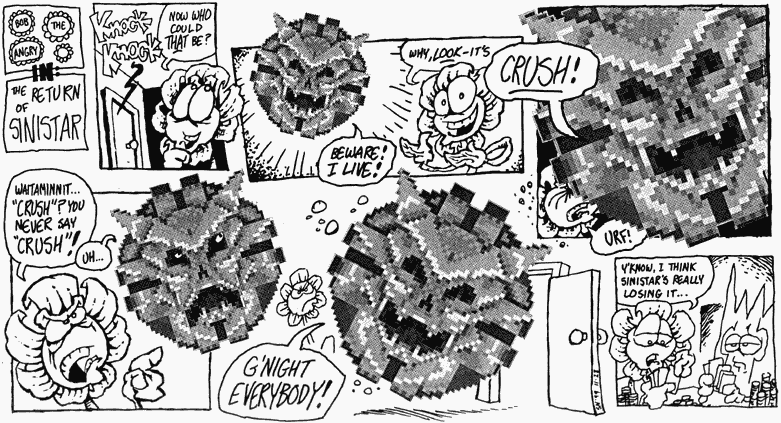
Sinistar: Things I just can't do.
 Just before the end of the first videogame boom, right before everyone thought that "fad" of going to arcades and hooking up interactive video machines to your TVs was just about dead, along came Sinistar, a game designed to instill fear in the minds of children, young adults, and grown-ups alike (or designed to allow you to destroy the greatest entity of evil so-far discovered in the universe; whichever). The game has certainly been ringing in my ears ever since. And I hadn't even been born at the time.
Now, when speaking of "things I just can't do," I'm referring to two very important senses of the human body: sound and touch (thank goodness technology prohibited the scent of Sinistar's eager appetite for U.S. quarters). Let's get touch out of the way, as we all know what sound(s) play an important role in the world of entertainment (even more so than that Wilhelm scream found in every Star Wars movie / videogame / television show / comicbook / cardgame).
Sinistar was the first game to use the 49-way joystick. Holy cow. Fourty-nine ways. I tried really hard to think of any more directions than the standard 8-way joystick already provided that could benefit the player's maneuvering through a starfield. A little Googling and it turns out it's just a 7x7 grid that's more accurate in reading the standard 8 directions. Still nifty. Anyway, the only upright cabinet experience I have available at the moment is in one of those 5billion-in-one machines that seem to think splotching together marquee art from every game into one hectic collage of action is a great marketing strategy to get people to come over and play. Regardless, it uses one kind of joystick to allow control for a wide array of different games. I think it's only a four-way stick, as I can't seem to move diagonally in any game that should allow it (thank you, Galaga, for restricting me to one dimension of movement). For those keeping track, that's 45 ways of direction I'm being deprived of when playing Sinistar. Needless to say, for a game designed around precision movement, being able to move in only four directions makes for some challenging play. I doubt it's just me that's causing almost every sinibomb to collide with a planetoid instead of that glass-jawed mechanical life vaccuum.
And now onto sound.
There's really only one other scream in my life I can't get out of my head that makes me just feel bad on the inside whenever I hear it, that being the howl of becoming a wolf in Altered Beast. It might have been the sudden drop of music for the audio clip, or how the transition animation was just a flickering bird-in-cage setup to make me think the human and wolf were one-in-the-same. Regardless, the event was a positive one, as it meant the player had maxed out his or her powerups and was ready to go beat the life out of Fester Addams.
 So, there may be seven very notable quotables to come out of Sinistar's planetoid hole, but the one I speak of is the yell he emits upon eating your ship. It's offensive; it's evil; it's blood-curdling; it's perfect. It makes me want to blow his face up (I love how grammatically incorrect that sounds, yet veterans may have trouble putting it any more accurately). His death call is even in stereo, another feature first seen in Sinistar. There's some dandy fansites out there, as well as an ingenius article titled "The Philosophical Revelations of Sinistar," referring to the character itself, though I must give credit to Noah Falstein for the work he did overseeing the game's completion.
And speaking of Noah Falstein, this here videoclip from ages past refers to an easter-egg hidden in the game. Deep in the game. So deep, in fact, that it isn't really documented anywhere that I can find. Well, anywhere except for an informal interview with Noah from sometime in the (I presume) 90s where he says, "There's an easter egg hidden in the attract mode, triggered by an odd combination of button presses that we've all forgotten, but soon I may have the chance to rediscover it..." I'm sure he's been bugged about this time and time again, but I feel the need to ask once more (because I have a good feeling he's reading this right now) - What is the easter-egg hidden within Sinistar?
There's a good chance this one will never be surfaced, much like the quest to find out what the common thread was between all of those Half-Life 2 teaser videos from 2003-04. It wasn't "the presence of broken toilets," and Gabe Newell's certainly not spilling the beans, so if anyone finds out, please do me a favor and fill me in.
Instead of just showing gameplay to the video, I'll link to a bunch of things - all surrounding Sinistar culture (yes, it's out there).
- Some gameplay (love those explosion sounds)
- The Seven Phrases of Sinistar
- Drum n Bass mix
- and another mix
- Sheena Easton music video where her boyfriend plays Sinistar?
And Noah, if you're reading this:
On the contrary; It was you who made my day.
[cross-posted on Gamasutra] [continue]...
Wednesday, April 1, 2009
Battle Garegga: More pink flamingos, please
 I don't know about you, but when I play shmups, I hold the fire button down until I either get a Game Over or beat the game. I capitalized "Game Over" because it is most definitely a proper noun. It's the last thing you see upon every play, and all-too likely, the most visible memory you have when thinking back to certain experiences (I shake my fist at thee, Andross). In the case of Ikaruga, the way the game is frozen while you enter your initials (or "AAA" in a fit of rage from missing that 4 mil mark on Chapter 1) and then reanimates back into motion with a mechanical buzzing sound of defeat is all it takes to make me want to come back and prove the game wrong. At least in Ikaruga, I know it's possible to come back and do better and get a little farther. At least the game is beatable when I do my best. I wish I could say the same for Battle Garegga.
Developed by Raizing, the game is one of those pivotal entries in the genre that helped define all of that manic craziness that we know and love. It apparently was a heavy inspiration for DoDonPachi's golden joyride, so why not love it, too? Probably because it hates you. I speak of course of the rank system in the game, an invisible collection of algorithms designed to slowly deteriorate you from the inside-out. Sure, rank systems are in all kinds of games, not just shmups. GTA IV has a dynamic system that changes the difficulty of missions based on how many tries it takes you to complete them. Left 4 Dead heavily uses a ranking system that fluctuates difficulty in real-time based on how well your party knows how to avoid being vomitted on. So why point out Battle Garegga's rank? Because if you just hold down the fire button, dodge every bullet, and collect every power-up, the game will become literally impossible to beat. It simply cannot be done. And it's all thanks to the omni-present rank which oversees your every move.
Unfortunately, the dedicated community over at the shmups.com forums have collected a compendium of knowledge around this one aspect of the game. Unfortunate, in how I now know just what goes into deciding the rank (quick summary: everything). Let's start with collectibles. If you touch a power-up, rank goes up. That goes for weapons upgrades, options (helper pods at your side), bombs, medals, and auto-fire upgrades (big no-no on touching those). If you shoot a bullet, rank goes up. If you use special bullets, rank goes up. Using a bomb, gaining a life, beating a boss, simply existing; it doesn't matter. Rank goes up (Yes, simply existing without dying makes rank go up). The list goes on. Rank is even so evil that it will sneak its way into your next play session, requiring a reset of the ROM or PCB or whatever you may be using to play it in order to get it back to default. The only true way, in fact, that lowers your rank is to die (what a wonderful lesson this game teaches us about life and its hardships). The less lives you have when you die, the further the rank is reduced (excluding having 1 life left, at which point dying will inevitably give the game another chunk of your soul).
 This may be bleak news, to find that anything you do in the game in order to survive and get ahead only pushes you further back. If I recall correctly, the final boss to Final Fantasy VII had a similar fate if you maxed out your characters' stats, rendering the battle impossible to win (making it even more ironic that the very final battle with Sephiroth is impossible to lose). I suppose on the bright side with Garegga, you don't have to invest dozens of hours into one game with no backup saves only to find that you can't beat it; that realization takes only a few minutes. The best way to play (i.e. complete) the game is to take your time collecting power-ups, avoiding certain power-ups altogether, only shooting when necessary, etc. Players going for score use this same recipe, though they incessantly dangle their fragile progress in front of the rank system, pushing it as far as it can go without causing an implosion of the game and its local universe.
Fortunately, as with almost all games in existence, there are a few tricks to getting an upper hand. There's a few sneaky ways to exploit massive point gain with some later bosses. My personal favorite is by hassling a flock of pink flamingos that found refuge in a castle, shrouded by a small forest, in the first half of level 2. Your fire disrupts their peace, forcing them to migrate north, at which point spraying them with more bullets / fire can cause your score to become an overnight millionaire. None of them seem to be harmed, so it's okay that I mention finding extreme joy in sending a flamethrowing special move into their haven.
I originally thought this game would be an ideal place to go for a good ole 1CC. Further reading made me not back off, but rather take my time with pacing if I ever wanted a shot at seeing some sort of credits roll. That rank system is just about as in-your-face as Sinistar's ego-centric taunts. At least Sinistar eventually shows his ugly grin.
Because showing a skillful run of this game is a slow and flavor-filled art, even under my respectful gaze, I'll just show you those awesome flamingos instead. They may be hard to see, but they're all flapping away from 0:28 to 0:38.
And finally, I wish the best of luck to Zakk from Hey Poor Player! in his endeavors to get a 1CC in Battle Garegga. [continue]...
Tuesday, March 24, 2009
Squares 2: Is [not] a shmup.
 It really shouldn't be a matter of opinion whether a game is a shmup or not. It either falls into the defined characteristics, or it doesn't. However, just like the many anomalies of the English language, so too do the rules of defining shmups (or any video game genre for that matter) delve into the realm of uncertainty.
First off, a "shoot 'em up" is more of what you do in the game, not what type of game it is. The same goes for "first-person shooter," which is simply a point of view and what you do. Calling Resident Evil a "survival horror game" is halfway there, though the survival part is just a tacked-on noun (and honestly, there are hundreds of other games that require you to survive, but don't mention it in the genre). I'm not even a fan of calling games "role-playing games," as I naturally enjoy playing the role of whatever character I'm playing, even Dr. Mario. I understand these genres put extra emphasis and dedicated TLC into their respective areas, but those same characteristics can be found in many other games. In these examples, it becomes clear that we can't simply use the literal meaning of a genre without getting into fisticuffs with ourselves.
That's why I find it interesting that there are games credited as - without a doubt - shmups, yet I can't help but disagree. And then there's shmups that shouldn't be deemed so, but have me welcoming them into the genre with open arms. Take for example Rez, which most definitely has you shooting things up. In fact, it's the only action you can do in the game other than moving across an X-Y plane. Yet I can't bring myself to call it a shmup. Something doesn't feel right about letting it into the genre, knowing all of the other fantastic characteristics that require mentioning. Calling it a shmup removes all of that effort made to hook up the soundtrack to your heartbeat; it makes us not wonder why there's so many different visual styles in which to play the game in one continuous sitting; it makes us not question the purpose of the hard-earned Trance Mission mode. To put Rez in a genre already occupied by so many dissimilar games would be inappropriate. I wouldn't dare place it somewhere it doesn't belong and I won't even mention the "s" word (but I'll gladly link to it). Also of note is how Space Harrier is near-identical in what you do, but I have no problem calling it a shmup.
On the other end of the spectrum, we have Geometry Wars 2. How can this game not be a shmup? You play the role of an abstract ship that flies around, can shoot out what look like bullets, can detonate bombs that clear the screen, and have various enemies to shoot until you run out of lives. That passes my test. Now let's take a look at one of the six gameplay modes, Pacifism, in which you have no bombs, cannot shoot, and must simply dodge the never-ending swarm of quadrilateral foes while collecting multipliers for a high score. This cannot be a shmup, for you physically can't shoot anything, and yet it still feels like a shmup. Granted, it helps that you can shoot things up in the other five modes, but this example brings me finally to a look at Squares 2, by Gavin Shapiro, in which you play the role of an abstract shape that cannot shoot, has no bombs, and must simply dodge the never-ending swarm of quadrilateral foes while collecting black squares (and sometimes circles) for a high score. Sound familiar?
 There have been games like this before, including the popular GBA homebrew game bulletgba, which is credited by the author as a "Bullet-Hell Simulator." However, those are bullet patterns right out of famous shmups, so it's too easy to associate the two. I'm focusing on Squares 2 because of how distant it is from the genre, yet it feels right at home. The game itself is not just my favorite addicting Flash game on the Internet (a simple search for "squares" in Google yields the game as the first result, showing a global popularity).
I find shmup charm in Squares 2 in how you have very limited time to react to on-the-fly patterns of things to dodge, all the while trying to collect as many black squares and circles as possible (thus giving you a reason to move and a motivation to survive, other than that shiny high score). And who cares if you have mouse-precision control over the shmup-traditional arrow keys / d-pad / joystick? Who cares if there's no end to the game? It's an endurance test (unless of course you're a cheater). The design of the game also helps out in its success: eye-catching red objects must be dodged, circular powerups / powerdowns stick out like sore thumbs, an annoying and undesirable buzzer sounds upon your failure, and the addictive audio crack that is Daft Punk plays on loop forever as you struggle to outdo yourself.
It's a beautiful formula that works to improve both your reaction time and how quickly you can interpret rapidly-changing patterns for the purpose of survival (a skill most definitely transferable to a traditional shmup and even reality). Keep in mind that the game is not perfect. The two biggest factors that take away from its appeal are how red squares sometimes spawn under black ones (quick fix: always have red squares at a higher depth than black ones) and how there are red circle powerdowns at all. If I had the choice to either touch a red square (knowing it ends the game immediately) or touch a red circle (knowing I'll continue with the game but suffer a minor penalty), I'll always choose the red circle. Why, then, are the red circles treated as these special-case "watch out for us!" entities, when it's the everyday red squares that are the real threats? I suppose only Gavin himself can fill us in.
The point I'm trying to make is that putting a game into one genre can be tricky and oftentimes unjust (a point also made by Mike Lopez from Gamasutra in relation to the racing genre). I like my shmups top-down, vertically scrolling, with lots of explosions, and a memorable experience that makes me wish I had more time in my life to perfect a playthrough... but that's just me.
Normally, I'd link to a video of the game at hand for those unaware of how it looks in motion. This time around, it's much more appropriate to just post a link to the game and have you play it yourself.
Speakers up, mouse area clear, and eyes alert: Here's Squares 2.
[cross-posted to Gamasutra] [continue]...
Tuesday, March 17, 2009
Raiden III: That poor, hapless driver
 Having much more to do with the morals and decisions of warfare than those of shmup mechanics and the did-you-ever-notice spiels I usually blurt out (although this entire post is about something I'm wondering if you've ever noticed), I'm interested in just what was going through the heads of the developers at Moss when they decided to allow you to kill an innocent bystander (actually a driver, but keep reading) in Raiden III for a rather uneven compensation.
The whole scenario unfolds within only a minute of starting your first mission. You begin soaring over what looks like a desolate and war-torn city, already in the midst of destruction and chaos. The only movement on the ground comes from tanks that are quite aggressively firing at you. All of a sudden, atop one of the highways, a red compact car blindly roars by from left field, entering the crossfire. Naturally, you'd just want to blow up everything in front of you, but on this specific occasion, you're blowing up much more than an enemy; this driver was trying to save his own life.
You may be wondering why I even care about that car. For all I know, it could have been driven by one of the generals of the opposing force, or even be a pilot running late to the hanger bays that morning. However, since it fires no bullets at you and simply wants to use the highway as it was originally designed, I can't help but feel guilty whenever I destroy it. The payoff is certainly not worth it, a measly 1000 points in exchange for his death. I eventually played through with the intent not to blow him up, and guess what? The car swerves out of the way of an oncoming tank before exiting the screen. He clearly was in a rushed, panicked confusion during this battle. And you just went and blew him up.
 This begins to make me wonder why I don't care about blowing up other by-standing things. In DoDonPachi, entire warehouses of who-knows-what are destroyed, simply for the pleasures of watching explosions and collecting stars (and possibly uncovering a fragile skeletal bee). In Guwange, the player sometimes blows up entire wooden watchtowers in 14th Century Japanese villages (while at a casual strolling pace, mind you). However, in none of these situations do the presumably destroyed individuals bare a soul, a will to live, or even a rather dashing vehicle.
I couldn't help but compare this fascination with the destruction of life to the 1996 movie Independence Day. Though destruction of innocent life goes on throughout the whole film, I feel quite differently when those immature alien-inviting New Yorkers are decimated as compared to how compassionate I am for the survival of Jasmine's dog Boomer when escaping a flame-engulfed tunnel (yes, I know - I'm just as shocked as you are that someone actually uploaded a screenshot of the very moment to which I'm referring). The point here is, we as an audience were swayed into having little-to-no emotion for the New Yorkers (though still just as innocent as those who weren't inviting the aliens) and had much love for a dog trying to escape fire alongside co-star Vivica A. Fox. Why did we feel this way? Because the dog wasn't a bad guy at all. He wasn't twisted or evil or filled with even the slightest hint of bad intentions. And neither was that red car.
For the sake of tying things back to shmups, here's actual footage of someone blowing up the unfortunate vehicle (@ 0:53). Note how an entire condo is blown up immediately afterwards and how little I care about it.
Know what's even worse? In Dual and Double modes, there are two cars careening to their doom atop that highway. A moment of silence for the blue car, too.
[cross-posted to Gamasutra] [continue]...
Monday, March 9, 2009
Warning Forever: Your own personalized Frankenstein
 There's no questioning that you are solely responsible for the personal Hell that you put yourself through when playing Warning Forever, my favorite entry from Hikoza Ohkubo's glorious (yet still in its infancy) library of experimental shmups. And rather than pay hundreds of dollars to legitimately play the games I've covered earlier (Radiant Silvergun being worth more eBay dollars than the number of max chains I can ever get in Chapter 2 of Ikaruga), this baby is free of charge and worth every second of your time. To get back on topic, Warning Forever (or in homage to Mr. Ohkubo's lust for the caps lock, WARNING FOREVER) is really the masochist's shmup, as it equally gives back what is put into it (and unfortunately for us all, there's no "give hug" button).
The real charm of this give-and-receive relationship with the boss (which happens to be the only enemy you fight in the game) is how your direct actions influence how it decides to evolve for the proceeding stage. Shooting its legs out makes it come back next time with fancy shin guards; demolishing its arms finds its return with a mighty thorax; and should you happen to be killed by a certain type of weapon, you can be sure it'll beef those bad boys up next come-around. There's always a fearful joy that comes about when the next boss presents itself, slightly upgraded, with just a little bit more mascara around the edges (a continuously-despised-yet-you-still-admit-to-enjoying it presentation paralleled only by the timeless Madonna). It's interesting, then, to note that it's never quite known how the boss will evolve its form, yet you just witnessed yourself perform every dodge, shot, and hit that influenced how it would go shopping for new body parts in between the last level and the current.
In this regard, you're essentially creating your own personalized Frankenstein that has no other pleasure in life than to destroy its maker (and for you bookworms, I realize I should be referring to the boss as a "personalized Frankenstein's monster," but for the sake of what Hollywood did to the name and how much more pleasing my version slips off the tongue, you'll just have to make the best with what you've got). Irony sets the tone with the coming of each stage, as the boss continually becomes better and better at pinpointing your strategies and weaknesses, all while your ship is never upgraded, save for your fingers' abilities in dodging and shooting the core.
 And on the topic of finger precision, there's more to the innovations list than the player-driven boss evolutions, that being the alternate firing method. Falling into the category of an arena shmup (wherein full 360-degree movement of player and enemies are integral to gameplay), it would have been ideal (and comfortably cliche) to have a set of four keys controlling cardinal direction of movement and an additional four designated for direction of fire. This has been simplified to four keys controlling all of the above via simple, intuitive gestures of the ship; moving forward and back widens and narrows the cone of fire, respectively, while strafing left and right rotates the cone. Firing locks it in place so you can keep your configuration while maneuvering through what inevitably becomes a dance around some heel-lickin' bullets. The design is simple, quick when needed, and long-lasting when working perfectly (though it does take a few run-throughs to get the gist of it. I suppose simplifying something more complex that's already accepted has that associated nature).
Another way to think of this game is that it's really just a "shmup boss designer" with a very interactive interface, that being your ship getting blown up more than you'd like to mention. The countdown timer, incessantly ticking in the corner, is certainly no aid in calming your nerves upon witnessing each grandiose rebirth of your recently-defeated foe, though it does add to how many beats per minute your heart reads when watching the title screen fade back into its mesmerizing flight across an abstract grid (Easter Egg Alert: The grid in the background can be controlled with the arrow keys, giving you a third entity to control with the same four keys. Nifty.).
Here's a run that shows the meaty mid-section of the game (bypassing the slower beginning stages and not spoiling how vastly large that sucker really gets). And if you look closely, you'll see that cone of fire I was talking about. It eventually blends in seamlessly.
[cross-posted to Gamasutra] [continue]...
Monday, March 2, 2009
Ikaruga: Eating dots for a healthier life
 For a game like Ikaruga, the concepts of meticulous memorization of movements, skillful execution of polarity-switching, and perfected timing are but a few of the many necessary ingredients for a successful playthrough. I don't know about you, but doing all of this is as stressful to my body as it is thrilling to succeed in (I can't be the only one with shaky wrists and a few beads of sweat on my brow after completing Chapter 4 on one credit). It then comes as a sort of shock to find that there's a hidden method of implicit play that comes from not firing a single bullet. For those familiar (I can sense a few heads nodding with a grin), feel free to relive your experiences in this post; for those new to the idea, I invite you to learn about one of the most calming and soothing times you'll ever have in a shmup. This is all about becoming a Dot Eater.
In similar fashion to collecting dogs in Radiant Silvergun, there's a secret ranking that is achieved upon fulfilling the requirements of never firing, but rather absorbing enemy bullets of your current polarity, appropriately named Dot Eater!. Because your score would be so pitiful compared to your score if you had gone for max chains, it's nice that the Dot Eater! ranking takes the place of the standard grading system (of C through the makes-you-look-good S++).
The way in which one plays as a dot eater is entirely up to that person. You could try and collect as many dots as possible, or see how seldom you need to move in order to survive. The first (of multiple) times my jaw dropped into self-discovered realization was in finding that the entire intro to Chapter 1 can be played without moving, or even changing polarity for that matter. The true beauty of enemy patterns and bullet fire comes out in full choreography, blossoming across the screen and exiting with as much grace as your involuntary arcs and passive dodges throughout each wave. Boss battles must be played out for the entire time limit, allowing you to appreciate the balance and harmony of bullet patterns (minding the oscillating swiftness of the bosses as they dance above you). Though you're still required to pay attention and act accordingly when needed, the fact that you only have to press one button to play greatly simplifies each chapter, effectively allowing your brain's extra processing power to see what you've actually been dodging all these years.
 I've even noticed that my breathing patterns are rhythmically tied to the ballet of maneuvers, a detail only apparent during the scoring screen following each chapter. The constant portrayal of the yin and yang throughout the game (can't forget that sweet tattoo on Buppousou's main body) shows its true form when everything from the game is kept intact, as if you were a passive entity moving through a balanced world, which is pretty much what it boils down to anyway. It feels as if there are equal parts of black enemies, black bullets, white enemies, and white bullets.
And speaking of passively moving through the world, there comes a point in Chapter 2 wherein there is a wall of impenetrable and polarized blocks, none of which can be destroyed following the way of the dot eater. The solution is ingenious, involving the precise positioning of your Ikaruga in between the cracks of any two blocks - a feat with a grace window of only a few pixels. The result? You effectively grant yourself a joyride through wall after wall of obstacles, as if you're behind the scenes, watching the play unfold from backstage. Demonstration here. I still wonder what it would feel like to dot-eat through Chapter 5, but something seems to continue stopping me every time.
Below is a complete DotEater run through Chapter 1, executed pretty nicely. Keep in mind that the experience I described above won't be seen in this video - you really have to go play for yourself. Not to worry, as the game is available on Dreamcast and Gamecube as a collector's item, as well as on Xbox Live Arcade for the why-don't-you-own-this-already price of $10.
We'll meet again someday soon :)
[cross-posted to Gamasutra] [continue]...
Wednesday, February 25, 2009
Sin & Punishment: Reading between the dimensions
 Deviating from my undying love of vertically-scrolling shmups (Tate mode forever ♥), I'd like to take a moment to observe a peculiar behavior of mine in Sin & Punishment. There's a section of Scene 2-1 (or as I like to think of it, the one after you take part in drowning Tokyo in a fiery sea of magma) wherein you have to defeat a miniboss that spews out an array of candy corn bullets. For whatever reason, I always find myself reorienting the camera, in my head, to be a top-down perspective, allowing me to dodge all bullets with ease. It seems way more difficult to view the bullets as is - a barrage of near-overlapping oranges that grow larger.
It makes me wonder, then, why Treasure (♥) decided to add this section of the game (to which I can't seem to find a similar one elsewhere). Level variety and their clever use of space aside, this seems apart from all of the other bullets-coming-at-you / creatures-crawling-towards-you stylings of seemingly everything else in the game. It could be that they originally tried out this bullet pattern and found that a closer camera made it too hard to see what's coming, or even the inverse - that their 3rd-quarter camera perspective allowed them to make more complicated patterns. And so they did.
The rhythmic pulsing of the bullet waves remind me heavily of a section in Chapter 2 of Ikaruga, shown here in a near-flawless run. The player must daftly maneuver through various symmetrical waves of bullets that need to be dealt with in one way or another. Although, in Ikaruga's case, the challenge here is in maneuvering through the unstoppable waves, while you were expected to obliterate the entire miniboss in S&P (to put things in very general terms, you dot-eating max-chainers out there).
Another way to think of this situation is to think of your character as a ship that has the added ability to "jump" (pun definitely intended) through different Z-depths, effectively dodging a particularly pesky array of life-stealing orange cones. True, this has been done before as far back as 1942 (the game, not the year) and Zaxxon (the video game, not the board game), but in this case you get to do it with a complicated control scheme.
Below, that very section of 2-1. I suppose this player wasn't thinking in the top-down fashion, hence the numerous errors. On the other hand, he seems to ace the subsequent sections, so I'm at a loss.
[cross-posted to Gamasutra] [continue]...
Monday, February 16, 2009
Radiant Silvergun: Takin the dog for a walk
 Going on side quests has always been something fun in videogames, from their gratuitous presence in MMORPGs, to their hidden subtleties in other games. They're usually carried out for the sake of gaining something of value, something that makes the trip worthwhile that makes the rest of the game even more fun. Surely there wouldn't be a quest in a game that gives you nothing other than bragging rights... right? Although I'm speaking specifically of the TopBreeder ranking in Radiant Silvergun, collecting dogs technically gives you points as you collect them (some worth even 1000 pts!!!), so there's at least something to be had whilst trying to collect them all.
For those not in the know, the TopBreeder ranking is acquired by collecting all 30 dogs hidden throughout the game, in one play-through. Dogs are always hidden, needing to be uncovered by your lock-on weapon. They give off a charming little "woof" that I suppose is a reward unto itself, if you happen to like dogs - the kind of dogs that require you to go out of your way amidst hundreds of oncoming enemy obstacles with the risk of losing that 1CC you've been numbing your rump over since you finished dinner the night before.
Nevertheless, this is something I can only assume is an extension of the director's personal life, possibly a life of training and breeding dogs. It's only natural for a game designer to want to take these "slices of life" and implement them into the game for a richer experience. In this case? I'm not so certain that collecting a score and a half of dogs adds to the experience of trying to destroy the root of all evil in the world (an abridged backstory of Radiant Silvergun), though the quest in itself gives you one more thing in the game to become obsessed about perfecting. At least it's not a feature that was supposed to be an inside joke, but ended up becoming frustrating to the rest of the world.
 There are so many different bonus quests that could have been added to this game. At this point, I could either go in the direction of listing more relevant quests or of listing even more oddball quests. Choosing the latter, I'm wondering why they didn't also include "porcelain ornament collecting", "replicas of the Wonders of the Ancient World collecting", and "prime factorizations of odd Fibonacci sequence numbers... collecting". Whatever. It's an added feature that was clearly odd enough to gain attention, optional yet functional, and popular enough to be talked about over 10 years after its initial release. Maybe I'm just looking forward to the equivalent feature to come with the arrival of project RS3. That's actually the primary reason I bought an XBox 360. One day, it shall be ours. Until then, go get 30 leashes and prepare to scour the depths of time and space for those adorable woofs, once again.
The magic happens when Lassie is captured at the 0:33 mark. Bottom right. Look closely.
And as always, be attitude for gains.
[cross-posted on Gamasutra] [continue]...
Tuesday, February 10, 2009
Galaga: When going left isn't always right
 There comes a time in every gameplay type's lifespan (usually occurring in its days of infancy, namely during the golden age of gaming) wherein key choices by the developers - oftentimes "happy accidents" - result in a gameplay mechanic that forever becomes a staple of every proceeding offering in that category. Since these types of behaviors are taken for granted and are as much a part of our lives as the stale taste of mushrooms is to Mario's mustache - especially in our seventh generation of games - I'm having trouble giving examples other than the one I'm about to discuss, that being the "fake out" in Galaga.
First, allow me to define the "fake out." This is a simple maneuver involving you, the player, to position yourself strategically on the screen such that the enemies' AI will think that's your chosen destination in which to chill for a while. Suddenly, you move in the opposite direction of your false dwelling, making for advantageous odds in your favor, whether they be for points, a power-up, having less to deal with, or simply to survive.
I speak of the "fake out" so fondly because it's a very important ingredient of our shmup lives. I've found that the very first implementation of its usage (and necessity) was in Galaga, released in 1981. Space Invaders may have come first, but all shots fired by the aliens were random (or at least unrelated to how awkwardly you hid behind your own bases in fear of losing too early in front of your friends). Galaxian may have come earlier, but its attack formations were too cosiney, allowing for easy escape. And for those toting the Xevious love, that didn't come along until the following year, so credit goes to Galaga. That was the first shmup that required you to perform the coveted "fake out" in order to survive.
 The setup is rather simple: A legion of enemies on the left side of the formation are just itching to dive in succession after your precious, quarter-starved bounty. You start to move towards the left, making it seem as if you're playing the safe route, surfing inside their tunnel of pain. They immediately change course, aiming right for your cockpit, both bullets and enemy ships glaring towards you. Suddenly, and without much reasoning, you dart towards the right - the very place they used to be going, but simply can't go to anymore (not because they spent time, money, and energy making on-the-spot changes in ship formations and coordination, but because they were programmed to stop following you once they've already plotted their course) - thusly rendering you safe, without worry of bullets, enemies, or even the dreaded forced-abduction with no lives left.
Here's a little taste of the subtlety that is the fake out. Note the subliminal one at 0:36. Just beautiful.
Oh, and on a side note: Awesome a bit?
[cross-posted on Gamasutra] [continue]...
Wednesday, February 4, 2009
Imperishable Night: Easier challenge means more adrenaline?
 In Imperishable Night's second level boss battle against Mystia Lorelei, there is one phase of the battle wherein most of the playable area of the screen is shrouded in darkness, despite an already hectic array of bullets dancing about in all directions (which also can be considered a clouded area of bullets, giving me even less content to speak about). All you have to work with is a small circular area surrounding you, forcing you to focus moreso on bullet dodging rather than shooting the boss as a top priority. I've commonly found myself leaning to the edge of my seat, sitting perfectly upright, licking my lips in anticipation, and giving off a wry smile that invites the game to "bring it on."
However, I sometimes stop to think why I get so excited over something like this. At first impression, it feels as if this phase requires exceptional reaction time and swift maneuvering in order to survive (both of which are certainly true), but for a few reasons, this phase is far easier than the rest of the battle.
First off, you have only a small area of the screen to worry about paying attention to, as opposed to the entire screen otherwise (but in my eyes, the player need only worry about this immediate surrounding area to successfully survive in any situation, sans unscheduled evacuations to other locations).
Second, in viewing the entire screen of bullets, the eye will quickly locate the bullets that are an obstacle and that pose an immediate threat, negating all others. Players of this game specifically know that early patterns of bullets will be in entirely different configurations by the time they get to you below.

 This brings me to question: Why does this portion of the boss battle bring the most tension, excitement, exhilaration, etc., despite it simplifying the game and bringing me to the most primitive of mechanics (the process of movement
 )? I suppose it's in the presentation. You're forced to watch this ominous, dark clouded area swallow up your battlefield, leaving you with little to hold onto by the time you gain back control. And then once you complete that phase, the viewable area becomes even smaller, making you feel as if there's no room to even breathe, let alone dodge seemingly hundreds of bullets.
Keep in mind that this phase would have failed design-wise if it weren't for a set-rhythm of bullets that are repeatable and not tied to player position. Thankfully, the barrage of sudden pain spikes is known to be escapable, a feature that makes the entire experience worthwhile and memorable.
And now, a section of the Level 2 boss battle of Imperishable Night:
[cross-posted on Gamasutra] [continue]...
Subscribe to:
Posts (Atom)

 Posts