Showing posts with label Ikaruga. Show all posts

Friday, July 1, 2011

June Happenings and the Final Theory

When I first created this blog, my intent was to get out a few ideas I had surrounding shmups. I wrote them all down in my sketchbook one particularly motivating day in February 2009. Back then I was posting once a week, eager to get all of these ideas out before they went stale. To my surprise, the blog took off, gaining readership by hundreds of people from around the world. Simon Carless himself asked me to crosspost my words of bullety wisdom to the then-new Gamasutra Expert Blogs. Things were great (i.e. chains were high), but then I started to run out of ideas. I slowed down to posting every two weeks, then to roughly every month, until I stopped posting for the latter half of 2010.

The Final Countdown
To this day, the site has gotten 20k+ views, excluding any feed readers out there (untrackable), so I'd say this has been pretty successful, especially for a blog without any ads, marketing, or under-the-table networking deals. I had gotten a few requests here and there during my lull to write some more SHMUPtheories. So I decided to make it my New Year's resolution to post a new something or other on the first day of every month in 2011. So far so good, but I don't see much of a future in 2012.

I'm not exactly saying this year will see the end of my writing about shmups and their theories. I see myself only writing from that point on when I think of something profound once again, something that captures my thoughts and doesn't let them go until I reason with them and walk away with a greater sense of understanding about the world revolving around bullets and superplays. Or maybe to boast about 1CCing Ikaruga (...one day, my old friend). Or maybe to get all giddy about RS3. Or maybe to continue touting my love for Treasure (♥). Who knows!

Around The Arena
This month, instead of focusing on some quirky quality about an element of a piece of a whole that makes up some obscure shooting game that only a handful of us have heard of, I'll instead give a bullet buffet of things happening in the world of shmups. Time to spread the love:
  • A chap by the name of BulletMagnet - a much respected aficionado in the shooting-things-up world - has lovingly put together a *FANTASTIC* write-up on everything shmups, appropriately entitled "Shmups 101: A Beginner's Guide to 2D Shooters". It's long, thorough, accurate, and filled with more nostalgia than the sound of inserting another quarter into a Galaga cabinet.
  • Cave, continuing to get hot and steamy with their love for porting arcade classics to the small screen, is getting ready to release Death Smiles for iPhone and iPod Touch. There's apparently some kind of live stream going on today (July 1) to show off some deathly gameplay (7:00am EDT, 8:00pm Japan), with the game releasing July 7th at a temporary discounted price. Get it.
  • Child of Eden came out. You've already played it. I haven't completed it yet, so no spoilers. I'll likely be covering this bad boy later in the year once I can pick my jaw up off the floor and collect my mental euphoria into coherent internet babble.
  • Eschatos and MuchiMuchiPork/PinkSweets combo pack are both still sold out or expensive everywhere. Does anybody know where these gems are available to a boy in the USA for less than $80? I've already accepted that importing is expensive, but maybe somebody knows of a secret shop somewhere I haven't heard of (worth a shot!).

Moving On Up (Highscores, I Mean)

I think I might have something special planned for the final scheduled [SHMUPtheory] of the year / ever (???). I've decided to not keep my posting intervals regular because, frankly, I've already said what I wanted to (and that was 2 years ago!). Even though more things will come to me that I will certainly want to talk about, there is an entire world out there of other things I'd also like to be talking about (referring to either videogames in general or life itself; can't decide).

I'm working fulltime on videogames, and making indie games in my freetime. Needless to say, games are still very much a significant part of my life, and will continue to be as such until basically the end of time. If I'm not making them, I'm playing them. If I'm not playing them, I'm discussing them. And when none of that is happening, I'm probably sleeping (which means I'm dreaming about them).

Until next month, keep those shots comin!

[cross-posted on Gamasutra]
[continue]...

Friday, April 1, 2011

That Was The Sound Of You Winning


I recently read through this plea to Roger Ebert in defense of videogames being art, despite his popularly permanent claim that they never were, nor will they ever be. I really don't want to get into that discussion, not only because no one has ever made a good case for it either way, but because humans are still having trouble figuring out what "art" is in the first place, let alone if a videogame can be considered one. I bring this up because of a mention of Radiant Silvergun in that letter, noting the change in audio during the final battle against the human-like mass of all evil in the universe (if confused, please go play). At that point, I was again reminded how important sound is to an experience like that. It's probably the most important factor in a videogame's success.

What Did I Just Listen To?
As I've heard in many places, "The best sound design is transparent." That is, a sign of truly successful audio engineering in an experience is when the audience/player doesn't complain about it afterwards. Listening is passive. You can't focus your ears like you do your eyes to something visual; you can only pay attention to it more (and to other senses less). It's this reason why sound is the easiest way to subliminally get into a person's head without him or her knowing. And if that sound was meaningful for play? Then it'll not only enrich the experience, but make you remember it well after having played.

We should all be aware of how sound is used in movies: Orchestras tell us how to feel at any given moment, regardless of on-screen content. A lack of music lets us know that the current moment is important (or someone is about to appear in the mirror behind the supporting character who's about to die). The hero's gun is always louder than the enemies' guns. All punches and kicks are amplified so you can hear how they feel to the recipient. I could go on, but I wanted to address audio in games.

Hearing Is Fun Again
Games today look pretty cool. They have a way to go before we finally say, "Sweet, graphics can no longer improve." As for audio, the surface has barely been touched. It's pretty easy to make music for a movie, since that movie will play out identically every time. You can shape the music specifically to make every ounce of the movie stronger through smart sound decisions. Games, however (obviously), will not be the same experience between any two people. This is why it's so much more complicated to create that perfect experience. While one player may get a pretty good string of audio in his playthrough, another may get stuck in an area and hear the same segment loop over itself to the point of disgust. This is why scrolling shmups are the closest to being able to control an environment, as the developers will know exactly where in the level you'll be at any given time.

So I'd like to take a closer look (listen?) to some of my favorite levels from shmups I'm sure I've linked to far too often by this point, pointing out areas that help improve the experience through audio. I'm not saying that these following examples are the height of human accomplishment in audible excellence. I'm also not saying that other games never even tried. Most AAA games today have so many fancy audio techniques going on that I'm proud to see (hear?) so much effort being put into something we'll never visualize. However, they're not shmups so I'm not talking about them.

Radiant Silvergun

As mentioned in that argument for games as art, this segment of the game makes a drastic change from epic synth orchestra to a choir of sadness. It was a perfect switch to cement the fact that the rest of humanity and existence is gone by this point, and only you are left in this world to destroy that which created hatred (spoilers? Seriously, just go play). This is the only one of my examples that is just a looping sample, but in contrast to the rest of the game's soundtrack it makes a deep impact. Also of note is how certain audio motifs from the main theme are still buried within the harmonic schemes heard here, avoiding a complete sense of disconnect.

ESP Galuda II

The way the music starts in the first level was actually a selling point for me importing this game for lots of money from Hong Kong. I know this genre of electronic JPop-y music isn't up everyone's alley, but there's some smart stuff going on. The beat doesn't really kick in until the player gets his first powerup. The music takes a breather just as the first large enemy explodes, creating a sense of wonder in what was just accomplished. The finale of the piece doesn't conclude until the player has finished off the miniboss. The most complex portion of the music starts when the screen floods with enemies/bullets for the first time. All of these cues to the gameplay hidden in the audio have been a staple of Cave's games in recent years, so not only do these practices exist throughout the rest of this game, but they can be found in almost everything they've put out in the last 10 years.

Death Smiles

This one is just weird. Though to be fair, this is a game centered around Halloween and general ghosts, ghouls, and goblins. The final boss, closely resembling Death (complete with scythe), is accompanied by Bach's Toccata and Fugue in D minor. The song has always been an icon of grim times, so it's no surprise that it's used here. I'm only pointing this out because the rest of the game's soundtrack was totally original in composition. This kind of took a gamble to break the 4th wall and remind you that these developers have been doing homework and researching how to make your experience better. And I know this has been done many times in games over the decades, even with this piece in particular. I'm just saying it worked well. It made the experience creepy. It's possible they tried to create something original, but similar to Bach's piece, failed, and just used his since it's in public domain now. Either way, it successfully creates the perfect mood against a pretty menacing final boss.

Ikaruga

I would have to say that all of Ikaruga's tracks are beautifully composed to match the experience going on. The music here not only helps to enforce emotional connections to what's going on, but also plays a vital role in providing cues for when certain patterns are going to appear (for score hounds like me, naturally). This level is by far the most complex (visually), and the score here does an excellent job of capturing that chaotic nature of movement, interaction, frustration, and hopefully success.

Listen Up
So the next time you recall a game you love, try thinking about the music that went along with it. It's likely you'll immediately be whistling main themes and boss battles. This is not only because you heard them so many times, but because you enjoyed those experiences. You've heard a lot of annoying commercials in your life, many times, but to ask you to recall their jingles would be a little more difficult (thank goodness).

And the next time you play a game, don't bother paying any more attention to the audio than you already do. After all, it's supposed to be transparent. It's likely you won't even be able to spot the best uses of the medium. And for that, I'm glad.

[cross-posted on Gamasutra]
[continue]...

Tuesday, March 1, 2011

Difficulty: Way Too Hard To Be This Easy


A Challenge of Choice
Shmups are one of the few kinds of games out there that are, from the start, as easy or as hard as you want them to be. Sure, you could make up your own implicit rules for any game to make things more interesting (my favorite new way to play a game being the Green Demon Challenge from Mario 64), shmups are naturally a bipolar beast. The question is: Would you rather beat it right now, or get a highscore later?

If you don't care about score; if you aren't interested in rank mechanics; if you don't want to earn your power-ups; if you don't care about second loops; you are probably one to want to simply beat the game. Fortunately for you, most shmups grant infinite continues, allowing a fairly uninterrupted session from title screen to final boss upon first playthrough. Some games, like Ikaruga, require you to earn your free credits through extended playtime, but the point is that they're eventually available.

Going Back for Seconds
And once you beat the game on your first shot by blazing through those continues? Maybe twenty minutes passed by. Over an hour if you were playing Radiant Silvergun (♥). Then what? If you didn't like the experience, you'll just move on to something else. If you liked it, how many times more will you play until you're tired of pressing Start to your heart's content? I would love if someone at this point realized the true potential of playing that same game with the intent of using less continues (preferably zero), but I am just a dreamer.

The truth we'd love to ignore is that once you get to see everything you'll be getting in a game, there's not much drive to go ahead and get good at it. Conversely, if you were only given as much of the game as you had earned, many people would be turned off by such strict filtering of game to the point of giving up (or "moving on to something else").

The Little Shmup That Could
Hydorah, a free and AMAZING game, does precisely this. I say amazing (nay, AMAZING), because the developer chose to keep some shmup rules from several decades ago: If you get a game over, there are no continues. The only way to get far in the game is to get good at it. How does one get good? This requires many plays through the game, starting with the first level, until the game has been beaten. What this amounts to is becoming exceedingly skilled at the beginning of the game, being fairly competent through the mid section, and being a vulnerable wanderer of hope in the final stages.

If you had the ability to replay stages you've unlocked, that would be great. If you had the ability to gain continues as you progressed through one session, that would be great. However, these great things are not in the game. In fact, there is a warning screen preceding the title screen - not to inform about the potential of seizure-inducing visuals, not to let us know about the relationship between winners and drugs, but to tell us how hard and unrelenting the game is going to treat us.


So, to say that this game is AMAZING is simply saying that I am amazed that this type of game was both created in modern times and accepted as rightfully as it would have been 25 years ago. To be fair, the entire game is a love letter to shmups of yesterdecade, namely the horizontal quarter-fests Gradius and R-Type. I'm glad this game exists. For every Hydorah that comes out - a polished, fine-tuned, intelligently-crafted game that harkens back to the days of dedicated skill-gaining power-hungry leaderboard overtakers - there are always dozens of relatively easy freeware/browser shmups that lack any sense of direction, challenge, flow, etc. Those games, unfortunately, have no hard method to play (unless they're poorly designed and are hard without reason or the ability to gain the necessary skills to overcome specific obstacles).

Why Try
This choice-driven difficulty is something special. You could be attempting a world record, get blind-sided by a strangely-generated bullet pattern, and then merrily give up and play the rest of the game using continues, no switch needing to be flipped. You could also do the opposite I guess, but your score wouldn't be all that impressive by the end (and wouldn't have any such notation on your ranking).

And let's not forget that score is only one drive to get to the end of a game on few credits. Simply beating any of these giants on a single credit is enough of a self-confidence boost to keep one feeling exceptionally proud for much longer than would be deemed healthy. There's also bragging rights, being able to play the true last boss of a game, getting all of the Achievements/Trophies, etc.

A True Man
The only thing stopping you from truly sitting down and dedicating yourself to a shmup and showing it how much of a man you are (ladies - you can be men, too) is if you want it. It's as simple as that. If you wanted to get to the top of that leaderboard, you'd be watching YouTube superplays and buying a new arcade stick instead of reading this. You'd be turning your monitor sideways and RSVPing regrets all weekend long. You'd know that you can do it, and you will do it, with enough perseverance, dedication, and energy drinks.

Or, if you just want to see what the rest of the game is like, if you've given up hope for the night and just want to shoot things, if you suddenly realized that leaderboards don't hi-five you back, then you can just press Start and use a continue. Just make sure you know what you're missing when you're granted another chance.

Hydorah trailer, complete with lovably cheesy voice work:


[cross-posted on Gamasutra]
[continue]...

Saturday, January 1, 2011

Geometry Wars 2: My 2009 New Year's Resolution


Catching Up
I've been getting enough requests over the months from friends, fans, and strangers for more SHMUPtheorizing. The reason I haven't posted in over six months is not because I ran of things to say. Nay, I still have much to share, probably more at this point. I've simply been busy. Since my last post, I've moved across the country, gotten a professional job making videogames at Namco, competed in two Flash game competitions (sorry, not shmups), and took part in various other activities that pushed this blog further down the priority lane. HOWEVER, the mere existence of this post should be more than enough evidence to convince you that [SHMUPtheory] is in no way dead. In fact, I'd like to release a new post every first of the month, and so I will. Starting today (Happy New Year, btw).

The celebrate, I'd like to share a milestone in my little world, a New Year's Resolution that I set for myself over a year ago. Actually, I think I made this promise to myself in December of 2008...

The Purchase; The Promise
I got my XBox360 a little late in the game, first signing into Live in December 08. My first purchase - without even debating it - was Geometry Wars 2. I had played the first and frothed over videos of the sequel. Though I also had Mirror's Edge (♥) at that time, I had to jump into the world of geometric bullet lust ASAP.

The achievements in GW2 were actually pretty quirky, usually requiring the player to pull off unorthodox playstyles (as was done in the first game if I recall correctly). The one that immediately captured my heart (i.e. time) was "Wax On, Wax Off", an achievement requiring the player to hug the entire perimeter of the gameplay walls in Pacifism mode not once, but twice. This was an ingenious way to trick the player into learning some advanced techniques of enemy manipulation fairly early into the experience. Once I got that achievement, I was hooked. There really wasn't a reason to play the other 5 modes (hyperbole, but still...).


The Challenge
Simply playing Pacifism for chuckles is not enough incentive to become obsessed. The true drive, as you all well know by now, is the Leaderboard. At the time, the highest score was just under 3 billion points (:O). My best was 300 million (._.). Needless to say, I had a ways to go. I decided at that point that if I surpassed one billion points, I would be content with my success, being placed comfortably among the top 100 players in the world. To attempt to get any higher would be to aim for first place, a feat that would never end as players continually gain skills over time.

For those unfamiliar, Pacifism mode sees the player not shooting, but dodging endless waves of blue rhombuses that spawn from the corners. To combat their growing forces, orange dumbbell gates appear randomly throughout the playfield, creating a proximal explosion when you fly through them. As vets know, the real challenge is in trying not to die by flying into the dumbbells and not so much getting swallowed by a sea of blue predators (though that is usually how the top scorers meet their end).

False Positive
I had spent almost a year working steadily on my dream score, only managing to come up with 478 million. The thing to keep in mind with this mode is that the score increases exponentially as your multiplier increases more linearly, so I was actually only a few more cycles away from my goal. The only problem is that after 100 million points, the amount of enemies spawned each time is significantly high enough to warrant a change in strategy, resulting in hurried movements, snappier decisions, and less time to react to sudden gate appearances.

One day I couldn't connect to Live, so I played around for funsies offline. Lo and behold, I had a shot at the title; However, I got a little too excited at my accruing success which led to my demise at roughly 780 million points. How did I almost double my score out of nowhere? It's a combination of both that exponential increase in score as well as my lack of pressure, thinking this was "just a practice run". There apparently is never just a practice run. Unfortunately for me, offline scores couldn't be uploaded to the Leaderboards upon reconnection, but who cares since it wasn't even a billion? If it were over a billion, I would have sold my Xbox and taken up a life of fly fishing. Okay, that's not true.


Really? Like this?
So then one day, sometime in October 2010, I broke not only my record, but my goal I had set almost two years earlier. And what was I doing? Chatting with a friend on Skype. Not paying attention. Not stressed. Just messing around with an analog stick while I talked long-distance with an ole chum. And yet I scored 1.2 billion points? Sometimes I don't understand how the mind concentrates and behaves under varied conditions. It's an accomplishment like this that tends to force one to reevaluate the training regimen required to accomplish a taunting task. Perhaps the next time I want to pull off something amazing, I should not even be focusing on it, instead relying upon chance, fate, ease of mind, and the warmth and positivity found through comradery.

What Now?
Well, I'm about done playing Geometry Wars 2, at least Pacifism mode. I may not be in the top 100 like I had planned - as players' scores have surpassed the 9 billion mark - but I still feel more than satisfied with my accomplishment. As of this writing, the top score is trailing the rest of the world with 9.123 billion points. Second place is at 7.819 billion, while I am #296 with 1,274,579,875 points. To be in my original goal range of the top 100, I'd have to surpass 2.162 billion points. While that would just be awesome, it's probably best to smile, enjoy the moment, and move on to something else.

I still really want to beat Ikaruga on one credit, though. Once I accomplish that, I won't have any more reason to say there is something in this world I cannot do. My success in Pacifism mode has rewritten what I had originally thought was the ideal state of mind and body in which to attempt a highscore/perfect run. It looks like I'll have unpredictability on my side to help me complete the game, namely Chapter 4.

Because the game has no replay mode, it's pretty cool that this guy recorded himself getting one of the highest scores in the world. Note how he swoops into his gate explosions to collect as many multipliers as possible, tempting the Game Over Gods. Great stuff:


Next Time, on [SHMUPtheory]
As I mentioned earlier, I plan to have a new [SHMUPtheory] post every 1st of the month, so hopefully I'll be able to keep up for a good while so you don't have to be disappointed when any given 2nd of the month rolls by without an update. Let's call this one of my New Year's Resolutions of 2011 :]

Also, for those interested in playing my Flash game competition entries I mentioned earlier, here they are, including my game [Yesterday] which recently won 1st place!
[cross-posted on Gamasutra]
[continue]...

Saturday, June 19, 2010

Bosses

Bosses are entities that have been in shmups since the beginning (okay, early '80s). Almost every scrolling shmup since then has had at least one by the end of the game, at the end of each level, or sporadically throughout the entire game. If a particular game ended a level without a boss, it would immediately feel as if something were missing, some challenge - a test - to prove one's worth to be able to continue to the next section. And then, sometimes, a boss has issues - it's easy, it's weird, it's unfair, etc. As I've learned in the world of story telling, the ending is the deal breaker. It can make a poor experience tolerable, make an amazing experience mediocre, and in some special cases, turn a waste of time into a reason to live.

The important thing to keep in mind when dissecting what exactly makes a good boss is that there is no universal answer. The boss must be dynamic in both design and execution, tailored specifically to the level in which it resides. Generally speaking, there are five main factors to consider when designing a boss: difficulty, variety, length of battle, pay-off, and character.

Difficulty
If this is the first boss of the game, make sure anybody who's at least trying will beat it without losing all of his or her lives. Losing on the first level - even if there are only a handful - is a buzz kill for even the most seasoned of veterans.

The types of attacks don't necessarily have to mimic the same enemy types seen earlier in the level, but they shouldn't be so vastly different that the boss and level feel separated in function. A level with homing rockets can have a boss with homing lasers. This is a simple evolution of what trials the player has already passed. You can also have the boss use weapons that won't be seen until the next level. The key is transition. If a boss uses attacks completely unrelated to both the theme and enemies found earlier in the level, it will feel unattached (and so will the player).

Variety
The player is going to want an intense battle. Intensity is not found through force, but through dynamism. The more varied attacks from the boss, the better. Many shmups visually separate the boss's health bar to show when the current attack pattern will end and a a new one will begin. However, within each of these sections of the boss's health, multiple different kinds of attacks can be cycled on a loop until the player dwindles enough health.

The weapons themselves can be the same, but the ways in which the player is to both dodge and attack should be different to some degree. If a player needs to find a sweet spot to camp and shoot, then find a different sweet spot for the next pattern, there wasn't a change in strategy. Thusly, the player won't be as engaged upstairs to feel as if he or she is up against something of challenge. Keep them on their toes, even when they know what pattern is coming up next. If they don't have to think during battle, then they won't think much of the boss when it's gone.


Length of Battle
Relatively speaking, if you know what you're doing to a boss, it's okay to defeat it in half the time it should normally take. On the other hand, if you have no idea what you're doing, it shouldn't take four times longer than expected to defeat it. The sense of accomplishment from grinding a tedious and unfulfilling battle is quickly diminished, no matter how great the pay-off (discussed below).

Globally speaking, the time it should take to defeat a boss should be relatively proportional to how long it takes to get through the level. Radiant Silvergun takes over an hour to complete not only because the bosses have such lengthy battles, but also because the levels themselves are lengthy. The durations of boss battles in Touhou games follow this same formula, as do most R-Types, Gradiuses, and Cave shooters. There are of course exceptions, such as having all or most of the final level be a boss battle, because the player expects to have one grand finale at the game's end. Consider this the one free pass you get.

As far as mid bosses go, they should never take longer to beat than the end boss (obvious yes, but still apparent in some shmups floating around online). This not only lets down the player with more battling after the mid boss, but the end boss is already considered a push over before the battle even begins (given previous playthroughs). Having an easy decoy boss that leads into a surprise harder boss is great, though the effect is only successful the first time around.

Pay-Off
The pay-off isn't necessarily just about the bonus points, collectible gems, bonus life, piece of triforce, or even a granted entry to the next level. The pay-off is what the player has gained by defeating the boss, whether it comes from programming within the game code or an experience that's been developed within the player's soul (too deep?).

This one is probably the hardest to explain, mostly because it's a different experience with every player. There's a rush that can be created through clever pacing of attacks and a false sense of impending doom.

Recent Cave shooters (Mushihimesama, ESPGaluda2) love having bosses that spit out everything they're made of immediately before being killed off. This creates an immediate thrill and sense of danger for the player, but it doesn't last so long as to erase his or her extra live stock within seconds.

Ikaruga's boss in Chapter 3 does the same thing, except instead of filling the screen with bullets, the whole boss spins radically faster and fires its lasers at a higher frequency (all while you're trapped inside).

In this sense, the boss battle intensity itself is a diagram of the level's difficulty leading up to and including the boss. To put it simply, the end of the boss battle should be more intense than the beginning.

Character
This kind of ties in with the thematic connection of attacks between the boss and the level in which it resides. Here, character is meant to describe the purpose for the boss being at the end, the reason why your progress is being halted by this dominating force. Everything is under subconscious scrutinization by the player: the reason that it breaks apart the way it does, the way in which it explodes (loyal readers must know by now how imperative it is to me for there to be a satisfying explosion for everything), the way it reacts to obvious flaws in its armor system, the sounds that are made when it charges up an attack / releases a final blow / gets angry at your skills, etc.

The villain is always the most important character in any story. Obviously, without him, there wouldn't be a hero (or anti-hero), yet there can still exist a villain without someone to combat him. It's in this sense that the villain is the source of there being any conflict (i.e. a hero cannot create a conflict, only solve it).

Great villains in cinema are tied very closely with movies that are successful. Biff from Back to the Future. Jafar from Aladdin. Dr. Evil from Austin Powers. Captain Hook from Peter Pan / Hook. Agent Smith from the Matrix. Darth Vader from ...yeah. I could go on, but these villains aren't just bad guys. They have a story behind why they turned out the way they are. And in turn, they behave in their worlds in response to whatever it is that ticked them off in the first place.

The same goes for videogames, although [unfortunately] they hardly ever seem to be as developed as those found in the movies (and to be honest, there really is no excuse). Sometimes a boss is never seen until the final battle. Sometimes we only know about the boss through cutscenes. Every story has two sides, and it's a bit unfair to the player to only see one side and not have the opportunity to enjoy what's going on behind the curtain.

Some excellent bosses in videogames would be GlaDOS from Portal, Donkey Kong from Donkey Kong, and the Stone Like from Ikaruga (and Radiant Silvergun?). All of these bosses / villains made themselves present throughout the player's gameplay experience, providing both a motivation to move forward as well as a satisfying pay-off at the end. To be fair, the Stone Like never was seen until the end, but everything that it put the player through was a marvelous final exam of everything that the player was supposed to learn throughout the game.


Putting It All Together
So what have we learned here? I, for one, know that I expect a lot when it comes to a good boss battle. However, I don't consider my expectations to be set too high. After all, we're talking about a boss battle here. This is the final challenge standing between the player and what the player set out to do: play the game.

The boss is a summary of what came before. It's a vision of what to expect next. It's the whole of the parts (which in turn shoots parts of the whole back at the player). It's the element by which to judge the entire game, as the boss itself is what the game eventually leads to.

So, the next time you play against a boss and feel remarkably underwhelmed, perhaps this attempt at categorizing the reasons will assist you in understanding why. Or, if you're developing your own boss to terrorize others, hopefully you've learned something along the way that you can implement into your creations (or at the very least, disagree with me hardcore and set out to prove me wrong :D)

[cross-posted on Gamasutra]
[continue]...

Saturday, April 3, 2010

Treasure: The Thrill of The Chase


Patterns in gameplay have existed since... well, since the first two videogames were released. They both had visuals and most likely interactivity as well. However, I'm talking about a pattern much more specific. In fact, I've only seen it done three times, and from the same company at that. Oh, Treasure (♥), how I unceasingly find intrigue in your existence. Read below to learn (and hopefully relive) "The Thrill of The Chase!"

The chase to which I refer can be found in Radiant Silvergun, Sin & Punishment, and Ikaruga. Though these games contain dozens of bosses, midbosses, subbosses, and minibosses, this chase occurs but once in each. Over the course of the three games, it has changed shape to accommodate both the mechanics of the game it's within and the undying thirst we have for a knowingly-conquerable challenge.

The basic recipe for this thrill chase is that you are either chasing or being chased by a subboss while avoiding both enemy fire and environmental hazards at a brisk pace. It's a workout for both the brain and the fingers, forcing the player to utilize all the mechanics of the game to not only win the chase, but to survive in general.

Radiant Silvergun: Stage 2 Midboss
Silvergun's is the most complex of the three, though it's probably the most manageable after a few go-arounds. There are sometimes split paths offered that are a win-lose situation: You may have an easier time surviving for the next 3 seconds, but the boss isn't losing health any faster. Consider this the pit-stop to give your rubber some time to cool off. This is also the only boss of the three games that attacks from both behind and in front of the player. I'm not counting Ikaruga (below) because the boss just sits down there, though you can still collide with it (and probably will the first few times).


Sin and Punishment: Stage 2-1 Midboss
S&P's version of the chase is the easiest to complete, though it's still no walk in the park. Besides the fact that there are split paths to follow in order to kill the boss quickly (time limit here this time), the game has bonuses littered throughout the chase to coax players into going for the major points at the risk of falling indefinitely. On the plus side, this boss doesn't fire back at you; he's kind of just concerned with running away from you, which makes you look like the killer. Regardless, the boss's actions give the player just enough split seconds to follow en route for a quick finish. This is the only chase of the three to also employ gravity as a mechanic, so timing [double] jumps is combined with strafing left and right, while of course collecting bonus points, firing a gun, and slashing floating bombs into the boss's rear end.


Ikaruga: Chapter 3 Midboss
This one is the killer. By this point, this is Treasure's third pass at making a chase that can really make the sweat drops glisten. Not only does this boss sway back and forth, but it constantly vomits out sprays from four companions as well as its own ugly mouth. On top of that, the sprays are alternating in polarity, so when one is crossing your path, you have to be ready to cut through the center stream and survive against an oncoming stream of the opposite polarity. I apologize for the skill level of the player in the video below. He actually does so well, you don't have much of a chance to appreciate anything (other than his dedication to turning a chase into t-ball practice).

This boss is known as one of the hardest sections in the game, which makes it all the more enjoyable to know that of all the changes Treasure made to the game for its XBox Live Arcade port, this boss had the most significant change. That change is that its companions spin in the opposite direction than they did in the arcade, Dreamcast, and Gamecube versions. Nothing too complicated for the pros, but you almost have to relearn this section from scratch, creating all new digital nightmares for your scoreboard to be plagued with when the console is turned off.


I hope I haven't missed other chase sequences in Treasure games of past. I'm relying on memory for Mischief Makers and Gunstar Heroes (which had a close call with the underground mine level), so if anyone can think of others, do share!

[Update: It's been brought to my attention that this chase can be found in two additional newer games: Gradius V and Sin & Punishment 2, both of which were also made by Treasure. Awesome. However, I can't offer too much insight on these, despite being able to easily find them on YouTube. I have this thing where I like to play Treasure games firsthand before spoiling anything online. I haven't gotten that far in Gradius V and S&P2 hasn't been released in the states yet, so I'll just have to assume that both of these chases are nothing short of thrilling. Thanks Evil_Toaster!]

[cross-posted on Gamasutra]
[continue]...

Wednesday, February 17, 2010

The Anatomy of a Shmup

If I haven't made it clear yet, I'm working on another shmup. This time, since I'm not restricted by a competition deadline, I've been paying close attention to the art behind creating shmups, both commercially and online. The big boys appear to be doing everything right. I only ever have a few nitpicks about them. If I ever feel like I don't like one, it's because of personal preference, not something that I can point out as being done poorly.

As for the indie shmups available for free or for a few bucks, they are hit or miss. Sometimes the design is ingenious, but the presentation is lacking. Sometimes the visuals are spectacular, but the gameplay is uninspired. Sometimes the game is pretty good, but could have been pushed further in various areas. There's a different reason for each game, but the importance here is that I'm taking notes on all of it.

Below I've gathered together a list of what I've observed over the months and years of playing. The ideas are in no particular order and only represent a fraction of my records. I thought I'd share them so you, too, can pinpoint a reason for any given game not being quite what you had hoped.

Keep in mind that not everything I say is required for every shmup. They each have their own place. Most of these notes are for scrolling and arena shooters, while some apply to any game or piece of art.
  • Enemy bullets should always be visible. The bullets shot by enemies should be visible on top of explosions, power-ups, other enemies, etc. The point here is that those bullets are your primary reason for not beating the game. Any time not spent being able to see them is time not spent preparing to engage them. If a foreground object is going to obscure the view of play, it's a good idea to make sure no bullets are on-screen. The only exception for hiding bullets is the HUD; for this reason, the HUD should be kept to a visual minimum.

  • Off-screen enemies should not be able to shoot. If the enemies aren't visible to the player, then how can a player even have a chance at feeling good about himself when dying from one of these bullets? This causes too much confusion, anger, and force quitting.

  • All bullets should have a ricochet/splash effect when hitting something. Without some sort of "splash" or "pop" effect to show contact, it makes it feel like either the bullets have no effect or they're passing under the enemy/obstacle in question.

  • Bullet collision should be accurate. This goes for any game where you can shoot and be shot at, but it's just a shame to be shooting something and having your bullets pass right by, or meeting the all-too-familiar death from a bullet that wasn't even in your area code.

  • If the player's ship has a small hitbox, make it obvious. I seemed to miss this point with my last shmup. The key here is to let the player quickly know his boundaries of death when in a crunch. Sometimes only a few frames of opportunity are available, during which time it's essential to be able to see where your sweet spot is.

  • The contrast between bullets and backgrounds should be high. This is something that's very important for survival, let alone for aesthetically pleasing visuals. An indie game for Dreamcast, Last Hope, had a special edition released that featured a higher bullet contrast. When Cave releases black label editions of their shmups, they oftentimes feature "darker background palettes". Also of note is that Cave has stuck with pink and bright blue colors for the bullets in all of their games. I guess they found the magic palette to make identifying bullets easiest.

  • Enemies should show some sign of being hit. If an enemy doesn't flicker or shake or shoot sparks when being shot, I can only assume that it is invulnerable to attack. The whole thing doesn't need to flash white (it really hurts the eyes with bosses), but there needs to be some indication of it taking damage. On that note, if an enemy is invulnerable (shields are up, boss hasn't settled yet, etc.), don't change a thing about it. Some games let your bullets pass through during these times, which is also fine.

  • Everything that is destroyed should explode. I'm almost completely serious when I say explode. As in fire and smoke. It doesn't seem to matter what the enemy is made out of; humans by nature love to see explosions and there's nothing more satisfying than watching something dangerous go up in flames. The Mushihimesama series gets around its insect/prehistoric theme by coloring its explosions blue, which in turn makes it look like a release of natural gas... or something. The point is, if you spend all that time pumping an enemy full of bullets, all of Newton's Laws say that it should explode into a fiery ball of satisfying pixelated splendor. And as far as boss explosions go, they better be a spectacular light show of gaseous fulfillment, including a screen-flooding flash of brightness that slows down gameplay.

  • There should be a sense of flow to each level. If you fast-forward through superplays of various commercial shmups, it becomes very clear that the design of each level is structured to force you to want to zig and zag all over the place. It not only keeps your wrists happy, but it never leaves you waiting in boredom. Radiant Silvergun and Ikaruga both reward quick killers with additional enemies to shoot while waiting for the next section to arrive. It's okay to have nothing to do while being warned about a boss. For one, this gives your eyes a chance to focus on the text. Second, it allows you to build up whatever fear/confidence that its presence concocts in your body. Even arena shmups like Geometry Wars and Echoes provide a flow in where the enemies spawn.

  • The visual style should be consistent through all levels, enemies, effects, menus, etc. The fact that this is something that every artist ever in history should be considering, it's sad to see it ignored so often. It's as if every 14-year-old with a wicked idea and limited freetime has used the same animated GIF of an explosion in his game. I was one of them. It's great as a placeholder, but if the rest of your game is composed of clean vector gradient fills, your explosion will not only look out of place; it will break gameplay. This happens a lot with uninspired menus as well, where a generic font is used without proper formatting. The end result can only make a player frown, no matter how spectacular the rest of the game looks.

  • There should be "popcorn" enemies in every level. These are enemies that blow up (with an explosion) after being hit once (or very seldom). The key here is quantity. Popcorn enemies not only fill in empty holes of time between waves of more viable forces, but they also make the player feel like he's the coolest kid on his block (and if he's playing a shmup, he automatically is).

  • There should be a way to save yourself in times of need. The most obvious method of saving one's life is the bomb. DoDonPachi also has a super/hyper beam. Ikaruga has homing lasers. Radiant Silvergun has a sword that slices everything in its path. The key here is that the player should be able to get out of a sticky situation. Most of these moves make the player invincible for a short amount of time, which in turn allows him to get out of physical obstacles as well as enemy fire.

  • If an enemy appears out of thin air on-screen, allow time for the player to ready himself. Never have an enemy appear in the middle of the screen and fly off at full speed shooting everything its mother taught it. It's okay for it to accelerate to its destined speed, or wait a second before firing. There can even be an indication of its arrival before it even appears. Geometry Wars does this with particle splashes. Works wonders. Believe me.

  • Enemy health should be either shown or predictable. Ikaruga shows the health of every enemy you start shooting at via a thin bar on the HUD. For games that show you nothing, you should be able to tell how long you need to be firing at an enemy before it's destroyed. Things like relative size or the presence of armor are usually good indications. If an enemy takes way too long to die, or if it explodes rather quickly, it will feel off, break gameplay, and your bewilderment over the developer's choosing of its health will put you into a stumper just long enough to be swallowed by an oncoming sea of bullets.

  • The coming of a boss should be made clear. This can be done through a large warning sign, the sound of a siren, the sound of nothing at all, or simply a lull in enemies, signifying the coming of something large. If you don't know that you're fighting a boss, then you won't try as hard, and you also won't be as enraged when you come close to defeating it and ultimately die. Think of it this way: If you told Mr. Magoo that he just walked through a construction zone that failed its last safety and security inspections, he probably wouldn't be as emotionally struck as Lando Calrissian would feel if you told him that he just blew up the second Death Star and narrowly avoided being engulfed by its own flames (see? everything explodes). If you think that's a silly argument to make because Lando would have already known what just happened, you're right. That's the point. He knew the whole time that he was escaping certain death. The stakes were high and his adrenaline was pumping in return. The whole experience was a ride. And that's what a player needs to feel before the boss even shows its ugly mug.

  • An unwanted sound should be heard when the player is hit/destroyed. The thought of losing a life and having to insert another quarter is enough to make a player avoid death, but the more that enforces that feeling of dread, the better. I think Squares 2 does this the best. The sound of that buzzer is the last thing I'd want to resonate in my ears, especially after having heard a looping sample from Daft Punk. Daft Punk!

  • There should always be a way out of every situation. Here, I'm talking about designing the enemies and bullet formations such that there is definitely a way to get through, at least by the developer. I know players can lose focus and corner themselves into a tight circle of pain, but that's going to happen in any game. If you dodge the wrong way, you're only setting yourself up for failure. Half the "fun" of bullet hell games is learning how to manipulate the enemies into shooting such that you will have a measely crevice through which to escape failure. This is sometimes called bullet herding, which is kind of awesome. Even Space Invaders had this in the form of being able to hide behind your bases. That counts, right?

  • Separate simultaneous bullet patterns should have different-looking bullets. The human brain is a beautiful thing, capable of recognizing complex patterns faster than any super computer today could ever hope to match (note: computers do not yet have hope). However, given the added sensations of stress, danger, and really fast bullets in large numbers, it would be such a great help if separate patterns had varied bullets. This can be achieved through color, shape, animation, and even rotation. The Touhou games are especially known for having hundreds of bullets on screen, each pattern distintively careening towards you at varying paces of fear induction.

  • Camera-shake is a privelage, not a right. The effect always looks cool. Let's get that out of the way. The problem is when camera-shake is used when every enemy is destroyed, every piece of gold is collected, and every bullet is fired. Not only does this make for too much visual noise for the player's eyes (Cloverfield was under an hour for a reason), but it also dampens the effect. The less it appears, the more it'll mean for the player when it does happen. Trust me - less is more.

As I've said before, all of these suggestions are optional and in my opinion. They're all things that I've seen implemented beautifully in console/arcade releases and miserably emulated in free online Flash games. Since I'm making a free online Flash game, I'm going to do my best to maintain a level of polish and attention to detail that allows the game to stay together as a whole. Even a single out-of-place sound effect can ruin the entire experience.

To kind of drive these points home, I'd like to use the same identifying features from the screenshot of Ikaruga above and apply them to Space Invaders. Ya know, for fun.

It would be mean to point out the games that I feel could have been more successful, even by just following my suggestions above, so I'll just talk about the free shmups that did a lot of things right.

- Arcanacra: Excellent flow of gameplay, superb use of sound (The enemies/attacks are synchronized with the music), enemy bullets stay visible, enemies show signs of taking damage, there are popcorn enemies, and the boss explosion is worth the trouble. This is the best free shmup that I've seen do so many things so well.

- Cube Colossus: Excellent visual style (nice explosions), unique and useful control mechanic, bullet contrast against backgrounds, engaging sound design (especially when buying upgrades), ample warning before bosses and spawning enemies, and enemies have visible health and show signs of taking damage.

- Death vs. Monstars: visually and audibly unique explosions, a simple control mechanic that allows for quick and accurate aiming, popcorn enemies, a spectacular boss explosion, and enemy bullets that stay visible.

- Heavy Weapons: Great use of sound (especially of enemies spawning nearby), effects and menus match visual style of the game, and of course there are many popcorn enemies.

[cross-posted on Gamasutra]
[continue]...

Thursday, February 4, 2010

Ikaruga: The Art of Chaining

Chaining. I've touched on this before, but I've wanted to do a video version for a long time. And, as it just so happens to be the one year anniversary of SHMUPtheory (Happy BDay, little guy), I felt like celebrating with something special. Below you'll find a 10+ minute video guide on how to chain the first chapter of Ikaruga, or at least how I do it. I spent quite a bit of time putting this thing together, especially when compared with how long it takes to type a regular post, so I hope you guys enjoy. Also, I realized it would probably be helpful to see the entire run without interruptions, so an additional uncut version is provided even further down.

Enjoy and happy chaining!


Below is the uncut version, since I realized it would make things a lot easier if the gameplay didn't pause every two seconds. This way it's much easier to learn timings (and sound cues).


[cross-posted on Gamasutra]
[continue]...
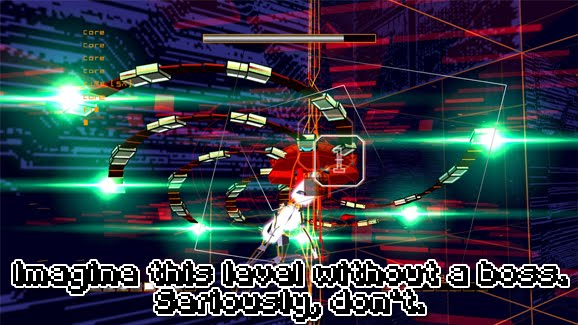
Tuesday, January 12, 2010

Lag, Control, and You

Talking about control isn't something that should be new to you. It's not some aspect of game design that slipped by your critical radar all these years and suddenly has been given new light. I'm sure you can still remember your thoughts when the Wii's controller was first unveiled; how impressed you were (and still are) at the SNES controller's simple, yet refined curves; how weird it was to see the Virtual Boy's double D-pad; how happy-yet-disappointed it was to see the Playstation controller evolve only under the hood - rather than on the outside - as each successive console was revealed. This is something that doesn't need to be said at all, as you should already know all of this. All of it. Still, though, I have things to say about control in relation to shmups. I'll try my best to stay on target.

First off, let's define something here: "control". Control is comprised of any and all aspects in games that allow you, the player, to interact with the game. The most prominent factors are some sort of input apparatus (e.g. a controller) and a monitor/television/Tiger Electronics LCD screen for viewing the status of a game. The factor I'm most concerned about is lag, which is no stranger to almost all other genres of games, especially fighters, racers, and FPSs.

Lag in itself means different things. We have:
  • 1. Lag from human response time - This is how long it takes you to see something, calculate what you want to do, convert that to controller inputs, and make your body carry out those actions. This takes longer for more complex inputs (such as the infamous "The Mohawk").
  • 2. Lag from controller-to-console-to-monitor - This is easily the shortest lag of all, yet it tends to gain the most hatred for ever existing. This also includes the online gaming route of controller-to-console-to-server-to-console-to-monitor.
  • 3. Lag from game-related issues - Intentional slowdown, intense calculations, etc. This technically takes place during lag #2, but it deserves its own recognition.
  • 4. Lag from Light - The time it takes for light to reflect off the monitor, travel through space, and into your retinas. I think I'll ignore this one.
And since we're all so visual nowadays, here are those same 4 kinds of lag, presented in one cohesive diagram:

Human Response Time Lag
In regards to response time, I don't have too much to say. This is the easiest lag to alleviate, though it takes the longest to achieve. The only way to make this lag go away is to keep on practicing until pressing buttons becomes second-nature. Luckily, practice in one game usually rolls over to other games, and even to other consoles. It varies from person to person. Some people are super quick at reacting, but aren't too accurate. Other people may take a few extra milliseconds to realize what's going on, but usually pull through. And of course there are people who are unfamiliar with their input device and have to look down at their hands more often than they look at the monitor.

Electronic Limitations Lag
Lag from the controller to the monitor is some kind of new-found beast in this generation. Back when we all had wired controllers and CRTs, no one even mentioned this. Now we've got Street Fighter IV vets who talk down upon wireless controllers' inferior speeds for sending input signals. There are forums dedicated to finding the right HDTV so as to minimalize the time it takes to process a composite signal into a digital format. Many HDTVs come with an option to switch to "Game Mode", which sacrifices cleaner visuals for less processing time.

As an avid fan and tournament-goer for Super Smash Bros. Melee, I can confirm for those out of the loop that pros will only play serious matches on CRTs. This is a fact across the United States and in international countries (I know you're there, Sweden, France, and Japan). Any HDTVs at a tourny are often used as the "just messin' around" TVs, the ones that are ignored during serious gameplay. Almost all players choose not to use the wireless Wavebird, despite its high review marks, to avoid any channel-switching shenanigans / battery-related tragedies. Does all of this attention to the saving of milliseconds make that much of a difference?

Yes. This is why MadCatz's billion-selling fight sticks have wires. They don't want any potential customer to doubt for a second that he or she will witness electric lag before purchasing one of these bad boys... especially when he or she will be dropping 150 big ones (i.e. dollars). Using HD cables on an HD console with a newer HDTV has become less of a problem. It's still there, but I feel technology is closing this short-lived chapter soon enough.

Intentionally Programmed / Intense Calculations Lag
When we press a button, we expect to see a result on the screen immediately (or rather, in such a quick manner that it feels instantaneous. Can't ignore physics after all.) If we press a button, wait, and then see the result appear on the screen, there had better be a good reason for it. Going back to Melee: if you try to jump, your character will first duck down and prepare for jumping, a Principle of Animation known as "anticipation". It makes the jump more believable, and only takes a few frames to accomplish. The game runs at 60 frames/second, so we're talking about a very short amount of time it takes to finally see your character leap into the air. This kind of lag is short enough to be ignored (...well maybe that's a poor example, as pros love to exploit this moment to wavedash all up and down their opponents' grills. It's hardly ignored at all and many players love to count frames to calculate how to achieve an added boost in--

Oh... right, shmups.

Intentional Lag in Shmups
The kind of input lag without immediate result that can really mess up gameplay can be found in many shmups. Let's look at Irukandji by Charlies Games. I hate to use this as an example, as I just love Charlie's other shmups to death, including the so-well-done (and 100% nsfw) Space Phallus, but I have a point to make here. The game takes place underwater. When you try to move, your ship takes a few frames to get up to speed, to simulate the water friction that would be found in such an environment. When you let go of movement inputs, the ship takes a few frames to slow down. This means if you want to move in a completely opposite direction than you currently are moving, then it takes about twice as long as usual to come to a stop, then start from rest and build that momentum back up to go the other way. The bullet patterns never get too complex to require intense weaving, and I totally understand that it's underwater and should feel like we're under water. But come on... this is a shmup.

I guess it makes little sense for a ship to be able to stop on a dime in any direction, but sometimes it's just needed. In shmups, it's almost always needed. And they're still tough as nails without any momentum lag. Plus, ya know, we have far more important things to complain about...

Here's a quick and dirty graph of the time it takes to reach full speed as compared with how much we should be tolerating it. I picked these games off the top of my head, so I can't exactly say they're accurately placed (especially since there are no numerical values for the axes). This graph is based simply off of my personal experience with them. Also note that the red bar exponentially reaches intolerability very rapidly.

Faster than Fast
It makes even less sense that most shmups allow your ship to move at full horizontal and vertical speeds when moving diagonally. The X and Y-axis movements are separate forces, so if you move diagonally, you actually end up combining their forces. Following Pythagoras, this means you'd technically be moving at ~1.414 times your normal movement speed. Ever wonder why speedrunners in FPSs move diagonally through worlds? Ever wonder why bunny hopping works so gosh darn well? Now you know.


That's all fine and dandy, but why don't more shmups force you to only move at your maximum speed? Many arena shmups impose this limitation, such as in Geometry Wars, but it's unheard of in vert and hori shmups. Why? Well, just think about it: As you wiggle through a swarm of pink death candy, you continuously hold [up] and sometimes press [right] to sneak through when an opening arises. If you could only move at maximum speed when moving in both directions, your vertical speed would slow down momentarily until you let go of [right]. This can very quickly become annoying and ultimately spell both your doom and a non-braggable NO RANK status at the leaderboard. It's cool with me to find this in arena shmups, especially when using analog sticks, since both your ship and the input device move in similar circular fashions.

Compensating for Something Small
It's possible to get used to sudden bursts and halts in speed as you weave in and out of certain death. It's possible to compensate for your ship's inability to change direction faster than in 0.2 seconds. It's possible for the mind to calculate everything happening on screen, tacking on an additional 0.2 seconds of leeway knowing that this one game was designed to feel more believable.

Back in the 56k modem days (33.3 for moi), we had to know when to let go of our sniper rifles' triggers in TFC, assuming the intended target would continue his trajectory and land under that big red spot just as the lag caught up and registered a hit. That was unnecessary skill, but we compensated. My point is, we shouldn't have to make that compensation, especially if the reasoning is because the developer(s) decided to make things not as responsive as they could have been.

True, there are plenty of instances where a little bit of intentional lag is passable, but when input-results become too delayed, the game isn't even worth getting good at. An exceptional exception is found in Mushihimesama Futari 1.5 (gazuntite) for Xbox360. The game intentionally creates gamespeed lag when too many bullets/killer insects are on screen (so as to emulate the arcade version). Your beetle-ship still responds faster than Lassie at an unsupervised well, but the whole game is slowed momentarily, allowing you to make even Neo a bit jealous.

Shameless Plug
And for those of you who were patiently waiting this whole time to make a comment about my own shmup's ship taking a little too long to move back and forth, I know. Trust me, I know. I obviously had my reasons, but I don't think they really make a difference at this point (especially after having rambled for much longer than was needed for something you already knew). If I ever make another shmup, rest assured you'll be stopping on dimes and moving at ~1.414 times your maximum speed all day.

[cross-posted on Gamasutra]
[continue]...

Saturday, October 31, 2009

Ikaruga Pumpkin Carving: Halloween Harmony

I know this isn't exactly a post that breaks apart the inner workings of gameplay and interprets them while comparing against similar games in a category, but I figure since it has everything to do with shmups (more importantly Ikaruga), and because I spent over 6 hours from gutting to cutting - roughly the amount of time spent writing a decent-sized SHMUPtheory blogpost - then this is more than acceptable to share with everyone. Afterall, it's Halloween. Full video and images after the jump!


It was a pleasure to work on this pumpkin, doing my best to balance the blacks with the whites (or rather the bright oranges with the dark oranges), much in the way that Ikaruga is best remembered. Not only was this project a challenge, but I had an added challenge of trying to stay away from my new TE Fight Stick I got this week, which would have gone to use in the playing of... well, Ikaruga (and maybe some SFIV when I muster up the confidence in Focus-attack-dash-cancelling). However, it's all done and I'm happy with the results.

And to answer the question that didn't just come to your mind: No, none of the roughly 100 kids that came to my door had any clue what they were staring at when they saw this... other than the fact that it was a pumpkin. Enjoy the rest of your Halloween and remember not to eat that candy too quickly!


[continue]...

Thursday, July 9, 2009

Ikaruga: Line Graphs Don't Lie

Graph definitely not to scale.

I suppose this whole fascination came about when I checked the Xbox360 leaderboards for all players in the world who completed Chapter 5 on Hard Mode with a rank of Dot Eater. There is only one. Even on Normal Mode, there are about 14. Chapter 4 has just over a dozen people who have even completed the chapter as a Dot Eater. Don't even worry about score at that point; completion appears to be enough of a reward. Combine this with my curiosity from why I rank so highly in Normal Mode without even touching the last 40% of the game, and the question comes to me: Just how many people play Ikaruga?

The only method I could think of was to scroll through the leaderboards manually. You can't just press UP from the top of the list, so I had to take the long route, 100 scores per screen, for 832 screens. My wireless controller went into sleep mode three times, once every 24,000 players, while I passed the time watching this fantastic tool-assisted speedrun of Mario 3. Naturally, I jotted down some data along the way, as the path to finding the worst-ranked player also reveals all players' scores at the same time.

For the sake of being fair in my analysis, this leaderboard is not a comprehensive list of every Ikaruga player in the world. Obviously, we have people who only played it in arcades (the lucky ones), on GameCube, on Dreamcast, or on an emulator (missing the point altogether). Then, for the people who have the Xbox version, there are those who downloaded it and never logged back in to Xbox LIVE (thereby never uploading a score for the board), those who changed settings from default, or those who only played on Easy Mode, Hard Mode, or a 2-Player equivalent. There are also guest profiles on those 360s that cannot have their scores uploaded to the online boards. Bummer. The point is: Normal Mode through all Chapters using default settings is what most people will play, as it's what happens if you keep pressing the A button at the title screen.

Knowing all of this, with what little merit this list has anymore, we can safely assume this is a good ballpark figure for the community as a whole. After over 30 minutes of rubberbanding the controller (Thank you, Gran Turismo), I can say that there have been 83,279 unique active players in Ikaruga. And the curve for those scores was fairly predictable (see image above). Knowing how brutally the learning curve treats players, the top score of 34.4 million points is quickly cut in thirds to 10.3 million by the 500th player. At 10,000 players, the score is at 1.3 million. From there, it has a steady decline in scores until around the 83,000th player, who has 11,100 points. The dead last player clearly had one goal in mind - to be the very last player on the list - with only 10 points. It appears others have tried to get the lowest score on the board, but many failed with 20 points. So far, only two people know the secret to getting a game over with only 10 points (something I can't figure out myself).

And speaking of low scores, I understand that the game is a tough cookie to play, let alone master, but many of these scores are just horrible. I'm trying my best not to be cocky about this, but if you just shoot at everything that comes at you without switching polarities or using homing lasers, you'll have about 200,000 points in your pocket by the end of Chapter 1, a score that about 20,000 people failed to acquire. If you just hold the fire button down and stare at the screen, you get a game over with 40,000 points, a score that over 4,000 people failed to acquire.

The only reasoning I can think of for these lower scores is that Ikaruga just wasn't the game these people thought it would be. Hype or word of mouth made them get the purchase, but the game was too intimidating, or some kind of Tom Clancy game came out that weekend and swept them off their feet. Everyone dies very early upon first playthrough. And for the next 50 to 500 playthroughs. But the more you play it, the more adept you'll become at simply surviving. These people may have tried, but they didn't continue trying, which is really the key here. Again, not their cup of tea.

An interesting trend I found in the scores is that duplicate scores never really appeared on the list until around the 70,000 player mark. I suppose this is just probability, as there are fewer digits available at this point (five, actually), allowing for fewer possible point totals.

So what have I gathered from all of this? Well, I now know I'm in the top 1% of the leaderboards, but I still have a few hundred hours of practice left until I beat the game. I'd say I've put in somewhere over 100 hours so far in my life. And I'm enjoying every moment of it. There appear to be tens of thousands of people who are no doubt trying their best to get the hang of the game, learning how to chain, how to survive, etc. In perusing forums for the game, I've seen that many beginner/intermediate players are still a little curious just how to go about chaining in the game. I'd be more than willing to put a video together explaining it, so do let me know if you're interested.

I also learned that if you want to be one of the few proud Dot Eaters in the world, give it a go in Hard Mode. I just tackled Chapter 2 last night, successfully pinning my name up alongside 40-some other brave souls in the world. I dare not venture into Chapters 4 and 5, as I'd hate to be the guy that undid the current guy's sole achievement in the world (though we all know it wouldn't happen even if I tried).

And to finish off the night, here's a wonderful little piece of information from the former top-ranking Ikaruga player in the world (now at a discomforting 4th place), who claimed that the game "is a joke," due in part because of how the port of the game to 360 saw the change in direction of the rotation of lasers that spin around a miniboss in Chapter 3. Kind of specific to be upset at the whole game, but I suppose few others deserve to say it than him. I, too, have been plagued by this minor change, yet it remains in the same collection of unreachable hurdles that the rest of the game has been known to present.

So anyway, let me know if a chaining tutorial would be up your alley.

[cross-posted on Gamasutra]
[continue]...