Showing posts with label galaga. Show all posts

Friday, July 1, 2011

June Happenings and the Final Theory

When I first created this blog, my intent was to get out a few ideas I had surrounding shmups. I wrote them all down in my sketchbook one particularly motivating day in February 2009. Back then I was posting once a week, eager to get all of these ideas out before they went stale. To my surprise, the blog took off, gaining readership by hundreds of people from around the world. Simon Carless himself asked me to crosspost my words of bullety wisdom to the then-new Gamasutra Expert Blogs. Things were great (i.e. chains were high), but then I started to run out of ideas. I slowed down to posting every two weeks, then to roughly every month, until I stopped posting for the latter half of 2010.

The Final Countdown
To this day, the site has gotten 20k+ views, excluding any feed readers out there (untrackable), so I'd say this has been pretty successful, especially for a blog without any ads, marketing, or under-the-table networking deals. I had gotten a few requests here and there during my lull to write some more SHMUPtheories. So I decided to make it my New Year's resolution to post a new something or other on the first day of every month in 2011. So far so good, but I don't see much of a future in 2012.

I'm not exactly saying this year will see the end of my writing about shmups and their theories. I see myself only writing from that point on when I think of something profound once again, something that captures my thoughts and doesn't let them go until I reason with them and walk away with a greater sense of understanding about the world revolving around bullets and superplays. Or maybe to boast about 1CCing Ikaruga (...one day, my old friend). Or maybe to get all giddy about RS3. Or maybe to continue touting my love for Treasure (♥). Who knows!

Around The Arena
This month, instead of focusing on some quirky quality about an element of a piece of a whole that makes up some obscure shooting game that only a handful of us have heard of, I'll instead give a bullet buffet of things happening in the world of shmups. Time to spread the love:
  • A chap by the name of BulletMagnet - a much respected aficionado in the shooting-things-up world - has lovingly put together a *FANTASTIC* write-up on everything shmups, appropriately entitled "Shmups 101: A Beginner's Guide to 2D Shooters". It's long, thorough, accurate, and filled with more nostalgia than the sound of inserting another quarter into a Galaga cabinet.
  • Cave, continuing to get hot and steamy with their love for porting arcade classics to the small screen, is getting ready to release Death Smiles for iPhone and iPod Touch. There's apparently some kind of live stream going on today (July 1) to show off some deathly gameplay (7:00am EDT, 8:00pm Japan), with the game releasing July 7th at a temporary discounted price. Get it.
  • Child of Eden came out. You've already played it. I haven't completed it yet, so no spoilers. I'll likely be covering this bad boy later in the year once I can pick my jaw up off the floor and collect my mental euphoria into coherent internet babble.
  • Eschatos and MuchiMuchiPork/PinkSweets combo pack are both still sold out or expensive everywhere. Does anybody know where these gems are available to a boy in the USA for less than $80? I've already accepted that importing is expensive, but maybe somebody knows of a secret shop somewhere I haven't heard of (worth a shot!).

Moving On Up (Highscores, I Mean)

I think I might have something special planned for the final scheduled [SHMUPtheory] of the year / ever (???). I've decided to not keep my posting intervals regular because, frankly, I've already said what I wanted to (and that was 2 years ago!). Even though more things will come to me that I will certainly want to talk about, there is an entire world out there of other things I'd also like to be talking about (referring to either videogames in general or life itself; can't decide).

I'm working fulltime on videogames, and making indie games in my freetime. Needless to say, games are still very much a significant part of my life, and will continue to be as such until basically the end of time. If I'm not making them, I'm playing them. If I'm not playing them, I'm discussing them. And when none of that is happening, I'm probably sleeping (which means I'm dreaming about them).

Until next month, keep those shots comin!

[cross-posted on Gamasutra]
[continue]...

Tuesday, January 12, 2010

Lag, Control, and You

Talking about control isn't something that should be new to you. It's not some aspect of game design that slipped by your critical radar all these years and suddenly has been given new light. I'm sure you can still remember your thoughts when the Wii's controller was first unveiled; how impressed you were (and still are) at the SNES controller's simple, yet refined curves; how weird it was to see the Virtual Boy's double D-pad; how happy-yet-disappointed it was to see the Playstation controller evolve only under the hood - rather than on the outside - as each successive console was revealed. This is something that doesn't need to be said at all, as you should already know all of this. All of it. Still, though, I have things to say about control in relation to shmups. I'll try my best to stay on target.

First off, let's define something here: "control". Control is comprised of any and all aspects in games that allow you, the player, to interact with the game. The most prominent factors are some sort of input apparatus (e.g. a controller) and a monitor/television/Tiger Electronics LCD screen for viewing the status of a game. The factor I'm most concerned about is lag, which is no stranger to almost all other genres of games, especially fighters, racers, and FPSs.

Lag in itself means different things. We have:
  • 1. Lag from human response time - This is how long it takes you to see something, calculate what you want to do, convert that to controller inputs, and make your body carry out those actions. This takes longer for more complex inputs (such as the infamous "The Mohawk").
  • 2. Lag from controller-to-console-to-monitor - This is easily the shortest lag of all, yet it tends to gain the most hatred for ever existing. This also includes the online gaming route of controller-to-console-to-server-to-console-to-monitor.
  • 3. Lag from game-related issues - Intentional slowdown, intense calculations, etc. This technically takes place during lag #2, but it deserves its own recognition.
  • 4. Lag from Light - The time it takes for light to reflect off the monitor, travel through space, and into your retinas. I think I'll ignore this one.
And since we're all so visual nowadays, here are those same 4 kinds of lag, presented in one cohesive diagram:

Human Response Time Lag
In regards to response time, I don't have too much to say. This is the easiest lag to alleviate, though it takes the longest to achieve. The only way to make this lag go away is to keep on practicing until pressing buttons becomes second-nature. Luckily, practice in one game usually rolls over to other games, and even to other consoles. It varies from person to person. Some people are super quick at reacting, but aren't too accurate. Other people may take a few extra milliseconds to realize what's going on, but usually pull through. And of course there are people who are unfamiliar with their input device and have to look down at their hands more often than they look at the monitor.

Electronic Limitations Lag
Lag from the controller to the monitor is some kind of new-found beast in this generation. Back when we all had wired controllers and CRTs, no one even mentioned this. Now we've got Street Fighter IV vets who talk down upon wireless controllers' inferior speeds for sending input signals. There are forums dedicated to finding the right HDTV so as to minimalize the time it takes to process a composite signal into a digital format. Many HDTVs come with an option to switch to "Game Mode", which sacrifices cleaner visuals for less processing time.

As an avid fan and tournament-goer for Super Smash Bros. Melee, I can confirm for those out of the loop that pros will only play serious matches on CRTs. This is a fact across the United States and in international countries (I know you're there, Sweden, France, and Japan). Any HDTVs at a tourny are often used as the "just messin' around" TVs, the ones that are ignored during serious gameplay. Almost all players choose not to use the wireless Wavebird, despite its high review marks, to avoid any channel-switching shenanigans / battery-related tragedies. Does all of this attention to the saving of milliseconds make that much of a difference?

Yes. This is why MadCatz's billion-selling fight sticks have wires. They don't want any potential customer to doubt for a second that he or she will witness electric lag before purchasing one of these bad boys... especially when he or she will be dropping 150 big ones (i.e. dollars). Using HD cables on an HD console with a newer HDTV has become less of a problem. It's still there, but I feel technology is closing this short-lived chapter soon enough.

Intentionally Programmed / Intense Calculations Lag
When we press a button, we expect to see a result on the screen immediately (or rather, in such a quick manner that it feels instantaneous. Can't ignore physics after all.) If we press a button, wait, and then see the result appear on the screen, there had better be a good reason for it. Going back to Melee: if you try to jump, your character will first duck down and prepare for jumping, a Principle of Animation known as "anticipation". It makes the jump more believable, and only takes a few frames to accomplish. The game runs at 60 frames/second, so we're talking about a very short amount of time it takes to finally see your character leap into the air. This kind of lag is short enough to be ignored (...well maybe that's a poor example, as pros love to exploit this moment to wavedash all up and down their opponents' grills. It's hardly ignored at all and many players love to count frames to calculate how to achieve an added boost in--

Oh... right, shmups.

Intentional Lag in Shmups
The kind of input lag without immediate result that can really mess up gameplay can be found in many shmups. Let's look at Irukandji by Charlies Games. I hate to use this as an example, as I just love Charlie's other shmups to death, including the so-well-done (and 100% nsfw) Space Phallus, but I have a point to make here. The game takes place underwater. When you try to move, your ship takes a few frames to get up to speed, to simulate the water friction that would be found in such an environment. When you let go of movement inputs, the ship takes a few frames to slow down. This means if you want to move in a completely opposite direction than you currently are moving, then it takes about twice as long as usual to come to a stop, then start from rest and build that momentum back up to go the other way. The bullet patterns never get too complex to require intense weaving, and I totally understand that it's underwater and should feel like we're under water. But come on... this is a shmup.

I guess it makes little sense for a ship to be able to stop on a dime in any direction, but sometimes it's just needed. In shmups, it's almost always needed. And they're still tough as nails without any momentum lag. Plus, ya know, we have far more important things to complain about...

Here's a quick and dirty graph of the time it takes to reach full speed as compared with how much we should be tolerating it. I picked these games off the top of my head, so I can't exactly say they're accurately placed (especially since there are no numerical values for the axes). This graph is based simply off of my personal experience with them. Also note that the red bar exponentially reaches intolerability very rapidly.

Faster than Fast
It makes even less sense that most shmups allow your ship to move at full horizontal and vertical speeds when moving diagonally. The X and Y-axis movements are separate forces, so if you move diagonally, you actually end up combining their forces. Following Pythagoras, this means you'd technically be moving at ~1.414 times your normal movement speed. Ever wonder why speedrunners in FPSs move diagonally through worlds? Ever wonder why bunny hopping works so gosh darn well? Now you know.


That's all fine and dandy, but why don't more shmups force you to only move at your maximum speed? Many arena shmups impose this limitation, such as in Geometry Wars, but it's unheard of in vert and hori shmups. Why? Well, just think about it: As you wiggle through a swarm of pink death candy, you continuously hold [up] and sometimes press [right] to sneak through when an opening arises. If you could only move at maximum speed when moving in both directions, your vertical speed would slow down momentarily until you let go of [right]. This can very quickly become annoying and ultimately spell both your doom and a non-braggable NO RANK status at the leaderboard. It's cool with me to find this in arena shmups, especially when using analog sticks, since both your ship and the input device move in similar circular fashions.

Compensating for Something Small
It's possible to get used to sudden bursts and halts in speed as you weave in and out of certain death. It's possible to compensate for your ship's inability to change direction faster than in 0.2 seconds. It's possible for the mind to calculate everything happening on screen, tacking on an additional 0.2 seconds of leeway knowing that this one game was designed to feel more believable.

Back in the 56k modem days (33.3 for moi), we had to know when to let go of our sniper rifles' triggers in TFC, assuming the intended target would continue his trajectory and land under that big red spot just as the lag caught up and registered a hit. That was unnecessary skill, but we compensated. My point is, we shouldn't have to make that compensation, especially if the reasoning is because the developer(s) decided to make things not as responsive as they could have been.

True, there are plenty of instances where a little bit of intentional lag is passable, but when input-results become too delayed, the game isn't even worth getting good at. An exceptional exception is found in Mushihimesama Futari 1.5 (gazuntite) for Xbox360. The game intentionally creates gamespeed lag when too many bullets/killer insects are on screen (so as to emulate the arcade version). Your beetle-ship still responds faster than Lassie at an unsupervised well, but the whole game is slowed momentarily, allowing you to make even Neo a bit jealous.

Shameless Plug
And for those of you who were patiently waiting this whole time to make a comment about my own shmup's ship taking a little too long to move back and forth, I know. Trust me, I know. I obviously had my reasons, but I don't think they really make a difference at this point (especially after having rambled for much longer than was needed for something you already knew). If I ever make another shmup, rest assured you'll be stopping on dimes and moving at ~1.414 times your maximum speed all day.

[cross-posted on Gamasutra]
[continue]...

Tuesday, April 14, 2009

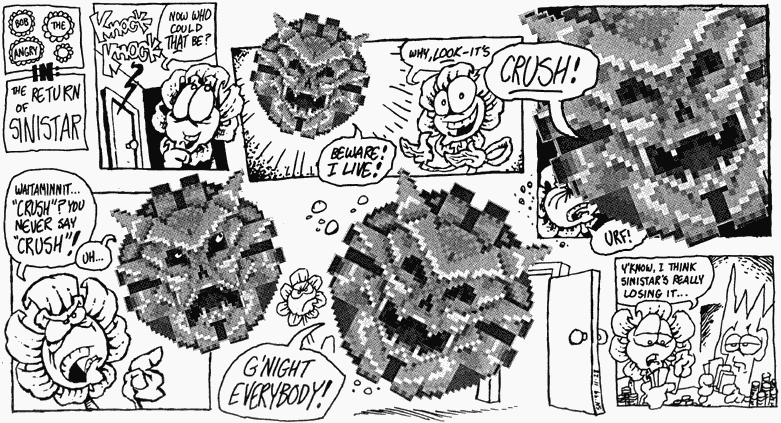
Sinistar: Things I just can't do.

Just before the end of the first videogame boom, right before everyone thought that "fad" of going to arcades and hooking up interactive video machines to your TVs was just about dead, along came Sinistar, a game designed to instill fear in the minds of children, young adults, and grown-ups alike (or designed to allow you to destroy the greatest entity of evil so-far discovered in the universe; whichever). The game has certainly been ringing in my ears ever since. And I hadn't even been born at the time.

Now, when speaking of "things I just can't do," I'm referring to two very important senses of the human body: sound and touch (thank goodness technology prohibited the scent of Sinistar's eager appetite for U.S. quarters). Let's get touch out of the way, as we all know what sound(s) play an important role in the world of entertainment (even more so than that Wilhelm scream found in every Star Wars movie / videogame / television show / comicbook / cardgame).

Sinistar was the first game to use the 49-way joystick. Holy cow. Fourty-nine ways. I tried really hard to think of any more directions than the standard 8-way joystick already provided that could benefit the player's maneuvering through a starfield. A little Googling and it turns out it's just a 7x7 grid that's more accurate in reading the standard 8 directions. Still nifty. Anyway, the only upright cabinet experience I have available at the moment is in one of those 5billion-in-one machines that seem to think splotching together marquee art from every game into one hectic collage of action is a great marketing strategy to get people to come over and play. Regardless, it uses one kind of joystick to allow control for a wide array of different games. I think it's only a four-way stick, as I can't seem to move diagonally in any game that should allow it (thank you, Galaga, for restricting me to one dimension of movement). For those keeping track, that's 45 ways of direction I'm being deprived of when playing Sinistar. Needless to say, for a game designed around precision movement, being able to move in only four directions makes for some challenging play. I doubt it's just me that's causing almost every sinibomb to collide with a planetoid instead of that glass-jawed mechanical life vaccuum.

And now onto sound.

There's really only one other scream in my life I can't get out of my head that makes me just feel bad on the inside whenever I hear it, that being the howl of becoming a wolf in Altered Beast. It might have been the sudden drop of music for the audio clip, or how the transition animation was just a flickering bird-in-cage setup to make me think the human and wolf were one-in-the-same. Regardless, the event was a positive one, as it meant the player had maxed out his or her powerups and was ready to go beat the life out of Fester Addams.

So, there may be seven very notable quotables to come out of Sinistar's planetoid hole, but the one I speak of is the yell he emits upon eating your ship. It's offensive; it's evil; it's blood-curdling; it's perfect. It makes me want to blow his face up (I love how grammatically incorrect that sounds, yet veterans may have trouble putting it any more accurately). His death call is even in stereo, another feature first seen in Sinistar. There's some dandy fansites out there, as well as an ingenius article titled "The Philosophical Revelations of Sinistar," referring to the character itself, though I must give credit to Noah Falstein for the work he did overseeing the game's completion.

And speaking of Noah Falstein, this here videoclip from ages past refers to an easter-egg hidden in the game. Deep in the game. So deep, in fact, that it isn't really documented anywhere that I can find. Well, anywhere except for an informal interview with Noah from sometime in the (I presume) 90s where he says, "There's an easter egg hidden in the attract mode, triggered by an odd combination of button presses that we've all forgotten, but soon I may have the chance to rediscover it..." I'm sure he's been bugged about this time and time again, but I feel the need to ask once more (because I have a good feeling he's reading this right now) - What is the easter-egg hidden within Sinistar?

There's a good chance this one will never be surfaced, much like the quest to find out what the common thread was between all of those Half-Life 2 teaser videos from 2003-04. It wasn't "the presence of broken toilets," and Gabe Newell's certainly not spilling the beans, so if anyone finds out, please do me a favor and fill me in.

Instead of just showing gameplay to the video, I'll link to a bunch of things - all surrounding Sinistar culture (yes, it's out there).
- Some gameplay (love those explosion sounds)
- The Seven Phrases of Sinistar
- Drum n Bass mix
- and another mix
- Sheena Easton music video where her boyfriend plays Sinistar?

And Noah, if you're reading this:
On the contrary; It was you who made my day.

[cross-posted on Gamasutra]
[continue]...

Tuesday, February 10, 2009

Galaga: When going left isn't always right

There comes a time in every gameplay type's lifespan (usually occurring in its days of infancy, namely during the golden age of gaming) wherein key choices by the developers - oftentimes "happy accidents" - result in a gameplay mechanic that forever becomes a staple of every proceeding offering in that category. Since these types of behaviors are taken for granted and are as much a part of our lives as the stale taste of mushrooms is to Mario's mustache - especially in our seventh generation of games - I'm having trouble giving examples other than the one I'm about to discuss, that being the "fake out" in Galaga.

First, allow me to define the "fake out." This is a simple maneuver involving you, the player, to position yourself strategically on the screen such that the enemies' AI will think that's your chosen destination in which to chill for a while. Suddenly, you move in the opposite direction of your false dwelling, making for advantageous odds in your favor, whether they be for points, a power-up, having less to deal with, or simply to survive.

I speak of the "fake out" so fondly because it's a very important ingredient of our shmup lives. I've found that the very first implementation of its usage (and necessity) was in Galaga, released in 1981. Space Invaders may have come first, but all shots fired by the aliens were random (or at least unrelated to how awkwardly you hid behind your own bases in fear of losing too early in front of your friends). Galaxian may have come earlier, but its attack formations were too cosiney, allowing for easy escape. And for those toting the Xevious love, that didn't come along until the following year, so credit goes to Galaga. That was the first shmup that required you to perform the coveted "fake out" in order to survive.

The setup is rather simple: A legion of enemies on the left side of the formation are just itching to dive in succession after your precious, quarter-starved bounty. You start to move towards the left, making it seem as if you're playing the safe route, surfing inside their tunnel of pain. They immediately change course, aiming right for your cockpit, both bullets and enemy ships glaring towards you. Suddenly, and without much reasoning, you dart towards the right - the very place they used to be going, but simply can't go to anymore (not because they spent time, money, and energy making on-the-spot changes in ship formations and coordination, but because they were programmed to stop following you once they've already plotted their course) - thusly rendering you safe, without worry of bullets, enemies, or even the dreaded forced-abduction with no lives left.

Here's a little taste of the subtlety that is the fake out. Note the subliminal one at 0:36. Just beautiful.


Oh, and on a side note: Awesome a bit?

[cross-posted on Gamasutra]
[continue]...