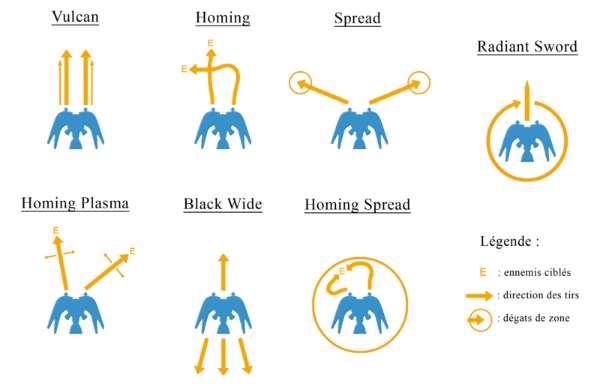
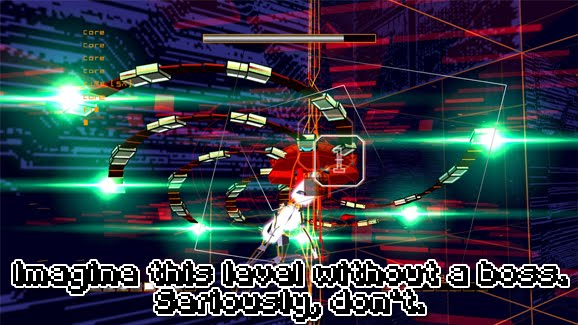
Showing posts with label radiant silvergun. Show all posts

Friday, April 1, 2011

That Was The Sound Of You Winning


I recently read through this plea to Roger Ebert in defense of videogames being art, despite his popularly permanent claim that they never were, nor will they ever be. I really don't want to get into that discussion, not only because no one has ever made a good case for it either way, but because humans are still having trouble figuring out what "art" is in the first place, let alone if a videogame can be considered one. I bring this up because of a mention of Radiant Silvergun in that letter, noting the change in audio during the final battle against the human-like mass of all evil in the universe (if confused, please go play). At that point, I was again reminded how important sound is to an experience like that. It's probably the most important factor in a videogame's success.

What Did I Just Listen To?
As I've heard in many places, "The best sound design is transparent." That is, a sign of truly successful audio engineering in an experience is when the audience/player doesn't complain about it afterwards. Listening is passive. You can't focus your ears like you do your eyes to something visual; you can only pay attention to it more (and to other senses less). It's this reason why sound is the easiest way to subliminally get into a person's head without him or her knowing. And if that sound was meaningful for play? Then it'll not only enrich the experience, but make you remember it well after having played.

We should all be aware of how sound is used in movies: Orchestras tell us how to feel at any given moment, regardless of on-screen content. A lack of music lets us know that the current moment is important (or someone is about to appear in the mirror behind the supporting character who's about to die). The hero's gun is always louder than the enemies' guns. All punches and kicks are amplified so you can hear how they feel to the recipient. I could go on, but I wanted to address audio in games.

Hearing Is Fun Again
Games today look pretty cool. They have a way to go before we finally say, "Sweet, graphics can no longer improve." As for audio, the surface has barely been touched. It's pretty easy to make music for a movie, since that movie will play out identically every time. You can shape the music specifically to make every ounce of the movie stronger through smart sound decisions. Games, however (obviously), will not be the same experience between any two people. This is why it's so much more complicated to create that perfect experience. While one player may get a pretty good string of audio in his playthrough, another may get stuck in an area and hear the same segment loop over itself to the point of disgust. This is why scrolling shmups are the closest to being able to control an environment, as the developers will know exactly where in the level you'll be at any given time.

So I'd like to take a closer look (listen?) to some of my favorite levels from shmups I'm sure I've linked to far too often by this point, pointing out areas that help improve the experience through audio. I'm not saying that these following examples are the height of human accomplishment in audible excellence. I'm also not saying that other games never even tried. Most AAA games today have so many fancy audio techniques going on that I'm proud to see (hear?) so much effort being put into something we'll never visualize. However, they're not shmups so I'm not talking about them.

Radiant Silvergun

As mentioned in that argument for games as art, this segment of the game makes a drastic change from epic synth orchestra to a choir of sadness. It was a perfect switch to cement the fact that the rest of humanity and existence is gone by this point, and only you are left in this world to destroy that which created hatred (spoilers? Seriously, just go play). This is the only one of my examples that is just a looping sample, but in contrast to the rest of the game's soundtrack it makes a deep impact. Also of note is how certain audio motifs from the main theme are still buried within the harmonic schemes heard here, avoiding a complete sense of disconnect.

ESP Galuda II

The way the music starts in the first level was actually a selling point for me importing this game for lots of money from Hong Kong. I know this genre of electronic JPop-y music isn't up everyone's alley, but there's some smart stuff going on. The beat doesn't really kick in until the player gets his first powerup. The music takes a breather just as the first large enemy explodes, creating a sense of wonder in what was just accomplished. The finale of the piece doesn't conclude until the player has finished off the miniboss. The most complex portion of the music starts when the screen floods with enemies/bullets for the first time. All of these cues to the gameplay hidden in the audio have been a staple of Cave's games in recent years, so not only do these practices exist throughout the rest of this game, but they can be found in almost everything they've put out in the last 10 years.

Death Smiles

This one is just weird. Though to be fair, this is a game centered around Halloween and general ghosts, ghouls, and goblins. The final boss, closely resembling Death (complete with scythe), is accompanied by Bach's Toccata and Fugue in D minor. The song has always been an icon of grim times, so it's no surprise that it's used here. I'm only pointing this out because the rest of the game's soundtrack was totally original in composition. This kind of took a gamble to break the 4th wall and remind you that these developers have been doing homework and researching how to make your experience better. And I know this has been done many times in games over the decades, even with this piece in particular. I'm just saying it worked well. It made the experience creepy. It's possible they tried to create something original, but similar to Bach's piece, failed, and just used his since it's in public domain now. Either way, it successfully creates the perfect mood against a pretty menacing final boss.

Ikaruga

I would have to say that all of Ikaruga's tracks are beautifully composed to match the experience going on. The music here not only helps to enforce emotional connections to what's going on, but also plays a vital role in providing cues for when certain patterns are going to appear (for score hounds like me, naturally). This level is by far the most complex (visually), and the score here does an excellent job of capturing that chaotic nature of movement, interaction, frustration, and hopefully success.

Listen Up
So the next time you recall a game you love, try thinking about the music that went along with it. It's likely you'll immediately be whistling main themes and boss battles. This is not only because you heard them so many times, but because you enjoyed those experiences. You've heard a lot of annoying commercials in your life, many times, but to ask you to recall their jingles would be a little more difficult (thank goodness).

And the next time you play a game, don't bother paying any more attention to the audio than you already do. After all, it's supposed to be transparent. It's likely you won't even be able to spot the best uses of the medium. And for that, I'm glad.

[cross-posted on Gamasutra]
[continue]...

Tuesday, March 1, 2011

Difficulty: Way Too Hard To Be This Easy


A Challenge of Choice
Shmups are one of the few kinds of games out there that are, from the start, as easy or as hard as you want them to be. Sure, you could make up your own implicit rules for any game to make things more interesting (my favorite new way to play a game being the Green Demon Challenge from Mario 64), shmups are naturally a bipolar beast. The question is: Would you rather beat it right now, or get a highscore later?

If you don't care about score; if you aren't interested in rank mechanics; if you don't want to earn your power-ups; if you don't care about second loops; you are probably one to want to simply beat the game. Fortunately for you, most shmups grant infinite continues, allowing a fairly uninterrupted session from title screen to final boss upon first playthrough. Some games, like Ikaruga, require you to earn your free credits through extended playtime, but the point is that they're eventually available.

Going Back for Seconds
And once you beat the game on your first shot by blazing through those continues? Maybe twenty minutes passed by. Over an hour if you were playing Radiant Silvergun (♥). Then what? If you didn't like the experience, you'll just move on to something else. If you liked it, how many times more will you play until you're tired of pressing Start to your heart's content? I would love if someone at this point realized the true potential of playing that same game with the intent of using less continues (preferably zero), but I am just a dreamer.

The truth we'd love to ignore is that once you get to see everything you'll be getting in a game, there's not much drive to go ahead and get good at it. Conversely, if you were only given as much of the game as you had earned, many people would be turned off by such strict filtering of game to the point of giving up (or "moving on to something else").

The Little Shmup That Could
Hydorah, a free and AMAZING game, does precisely this. I say amazing (nay, AMAZING), because the developer chose to keep some shmup rules from several decades ago: If you get a game over, there are no continues. The only way to get far in the game is to get good at it. How does one get good? This requires many plays through the game, starting with the first level, until the game has been beaten. What this amounts to is becoming exceedingly skilled at the beginning of the game, being fairly competent through the mid section, and being a vulnerable wanderer of hope in the final stages.

If you had the ability to replay stages you've unlocked, that would be great. If you had the ability to gain continues as you progressed through one session, that would be great. However, these great things are not in the game. In fact, there is a warning screen preceding the title screen - not to inform about the potential of seizure-inducing visuals, not to let us know about the relationship between winners and drugs, but to tell us how hard and unrelenting the game is going to treat us.


So, to say that this game is AMAZING is simply saying that I am amazed that this type of game was both created in modern times and accepted as rightfully as it would have been 25 years ago. To be fair, the entire game is a love letter to shmups of yesterdecade, namely the horizontal quarter-fests Gradius and R-Type. I'm glad this game exists. For every Hydorah that comes out - a polished, fine-tuned, intelligently-crafted game that harkens back to the days of dedicated skill-gaining power-hungry leaderboard overtakers - there are always dozens of relatively easy freeware/browser shmups that lack any sense of direction, challenge, flow, etc. Those games, unfortunately, have no hard method to play (unless they're poorly designed and are hard without reason or the ability to gain the necessary skills to overcome specific obstacles).

Why Try
This choice-driven difficulty is something special. You could be attempting a world record, get blind-sided by a strangely-generated bullet pattern, and then merrily give up and play the rest of the game using continues, no switch needing to be flipped. You could also do the opposite I guess, but your score wouldn't be all that impressive by the end (and wouldn't have any such notation on your ranking).

And let's not forget that score is only one drive to get to the end of a game on few credits. Simply beating any of these giants on a single credit is enough of a self-confidence boost to keep one feeling exceptionally proud for much longer than would be deemed healthy. There's also bragging rights, being able to play the true last boss of a game, getting all of the Achievements/Trophies, etc.

A True Man
The only thing stopping you from truly sitting down and dedicating yourself to a shmup and showing it how much of a man you are (ladies - you can be men, too) is if you want it. It's as simple as that. If you wanted to get to the top of that leaderboard, you'd be watching YouTube superplays and buying a new arcade stick instead of reading this. You'd be turning your monitor sideways and RSVPing regrets all weekend long. You'd know that you can do it, and you will do it, with enough perseverance, dedication, and energy drinks.

Or, if you just want to see what the rest of the game is like, if you've given up hope for the night and just want to shoot things, if you suddenly realized that leaderboards don't hi-five you back, then you can just press Start and use a continue. Just make sure you know what you're missing when you're granted another chance.

Hydorah trailer, complete with lovably cheesy voice work:


[cross-posted on Gamasutra]
[continue]...

Saturday, June 19, 2010

Bosses

Bosses are entities that have been in shmups since the beginning (okay, early '80s). Almost every scrolling shmup since then has had at least one by the end of the game, at the end of each level, or sporadically throughout the entire game. If a particular game ended a level without a boss, it would immediately feel as if something were missing, some challenge - a test - to prove one's worth to be able to continue to the next section. And then, sometimes, a boss has issues - it's easy, it's weird, it's unfair, etc. As I've learned in the world of story telling, the ending is the deal breaker. It can make a poor experience tolerable, make an amazing experience mediocre, and in some special cases, turn a waste of time into a reason to live.

The important thing to keep in mind when dissecting what exactly makes a good boss is that there is no universal answer. The boss must be dynamic in both design and execution, tailored specifically to the level in which it resides. Generally speaking, there are five main factors to consider when designing a boss: difficulty, variety, length of battle, pay-off, and character.

Difficulty
If this is the first boss of the game, make sure anybody who's at least trying will beat it without losing all of his or her lives. Losing on the first level - even if there are only a handful - is a buzz kill for even the most seasoned of veterans.

The types of attacks don't necessarily have to mimic the same enemy types seen earlier in the level, but they shouldn't be so vastly different that the boss and level feel separated in function. A level with homing rockets can have a boss with homing lasers. This is a simple evolution of what trials the player has already passed. You can also have the boss use weapons that won't be seen until the next level. The key is transition. If a boss uses attacks completely unrelated to both the theme and enemies found earlier in the level, it will feel unattached (and so will the player).

Variety
The player is going to want an intense battle. Intensity is not found through force, but through dynamism. The more varied attacks from the boss, the better. Many shmups visually separate the boss's health bar to show when the current attack pattern will end and a a new one will begin. However, within each of these sections of the boss's health, multiple different kinds of attacks can be cycled on a loop until the player dwindles enough health.

The weapons themselves can be the same, but the ways in which the player is to both dodge and attack should be different to some degree. If a player needs to find a sweet spot to camp and shoot, then find a different sweet spot for the next pattern, there wasn't a change in strategy. Thusly, the player won't be as engaged upstairs to feel as if he or she is up against something of challenge. Keep them on their toes, even when they know what pattern is coming up next. If they don't have to think during battle, then they won't think much of the boss when it's gone.


Length of Battle
Relatively speaking, if you know what you're doing to a boss, it's okay to defeat it in half the time it should normally take. On the other hand, if you have no idea what you're doing, it shouldn't take four times longer than expected to defeat it. The sense of accomplishment from grinding a tedious and unfulfilling battle is quickly diminished, no matter how great the pay-off (discussed below).

Globally speaking, the time it should take to defeat a boss should be relatively proportional to how long it takes to get through the level. Radiant Silvergun takes over an hour to complete not only because the bosses have such lengthy battles, but also because the levels themselves are lengthy. The durations of boss battles in Touhou games follow this same formula, as do most R-Types, Gradiuses, and Cave shooters. There are of course exceptions, such as having all or most of the final level be a boss battle, because the player expects to have one grand finale at the game's end. Consider this the one free pass you get.

As far as mid bosses go, they should never take longer to beat than the end boss (obvious yes, but still apparent in some shmups floating around online). This not only lets down the player with more battling after the mid boss, but the end boss is already considered a push over before the battle even begins (given previous playthroughs). Having an easy decoy boss that leads into a surprise harder boss is great, though the effect is only successful the first time around.

Pay-Off
The pay-off isn't necessarily just about the bonus points, collectible gems, bonus life, piece of triforce, or even a granted entry to the next level. The pay-off is what the player has gained by defeating the boss, whether it comes from programming within the game code or an experience that's been developed within the player's soul (too deep?).

This one is probably the hardest to explain, mostly because it's a different experience with every player. There's a rush that can be created through clever pacing of attacks and a false sense of impending doom.

Recent Cave shooters (Mushihimesama, ESPGaluda2) love having bosses that spit out everything they're made of immediately before being killed off. This creates an immediate thrill and sense of danger for the player, but it doesn't last so long as to erase his or her extra live stock within seconds.

Ikaruga's boss in Chapter 3 does the same thing, except instead of filling the screen with bullets, the whole boss spins radically faster and fires its lasers at a higher frequency (all while you're trapped inside).

In this sense, the boss battle intensity itself is a diagram of the level's difficulty leading up to and including the boss. To put it simply, the end of the boss battle should be more intense than the beginning.

Character
This kind of ties in with the thematic connection of attacks between the boss and the level in which it resides. Here, character is meant to describe the purpose for the boss being at the end, the reason why your progress is being halted by this dominating force. Everything is under subconscious scrutinization by the player: the reason that it breaks apart the way it does, the way in which it explodes (loyal readers must know by now how imperative it is to me for there to be a satisfying explosion for everything), the way it reacts to obvious flaws in its armor system, the sounds that are made when it charges up an attack / releases a final blow / gets angry at your skills, etc.

The villain is always the most important character in any story. Obviously, without him, there wouldn't be a hero (or anti-hero), yet there can still exist a villain without someone to combat him. It's in this sense that the villain is the source of there being any conflict (i.e. a hero cannot create a conflict, only solve it).

Great villains in cinema are tied very closely with movies that are successful. Biff from Back to the Future. Jafar from Aladdin. Dr. Evil from Austin Powers. Captain Hook from Peter Pan / Hook. Agent Smith from the Matrix. Darth Vader from ...yeah. I could go on, but these villains aren't just bad guys. They have a story behind why they turned out the way they are. And in turn, they behave in their worlds in response to whatever it is that ticked them off in the first place.

The same goes for videogames, although [unfortunately] they hardly ever seem to be as developed as those found in the movies (and to be honest, there really is no excuse). Sometimes a boss is never seen until the final battle. Sometimes we only know about the boss through cutscenes. Every story has two sides, and it's a bit unfair to the player to only see one side and not have the opportunity to enjoy what's going on behind the curtain.

Some excellent bosses in videogames would be GlaDOS from Portal, Donkey Kong from Donkey Kong, and the Stone Like from Ikaruga (and Radiant Silvergun?). All of these bosses / villains made themselves present throughout the player's gameplay experience, providing both a motivation to move forward as well as a satisfying pay-off at the end. To be fair, the Stone Like never was seen until the end, but everything that it put the player through was a marvelous final exam of everything that the player was supposed to learn throughout the game.


Putting It All Together
So what have we learned here? I, for one, know that I expect a lot when it comes to a good boss battle. However, I don't consider my expectations to be set too high. After all, we're talking about a boss battle here. This is the final challenge standing between the player and what the player set out to do: play the game.

The boss is a summary of what came before. It's a vision of what to expect next. It's the whole of the parts (which in turn shoots parts of the whole back at the player). It's the element by which to judge the entire game, as the boss itself is what the game eventually leads to.

So, the next time you play against a boss and feel remarkably underwhelmed, perhaps this attempt at categorizing the reasons will assist you in understanding why. Or, if you're developing your own boss to terrorize others, hopefully you've learned something along the way that you can implement into your creations (or at the very least, disagree with me hardcore and set out to prove me wrong :D)

[cross-posted on Gamasutra]
[continue]...

Saturday, April 3, 2010

Treasure: The Thrill of The Chase


Patterns in gameplay have existed since... well, since the first two videogames were released. They both had visuals and most likely interactivity as well. However, I'm talking about a pattern much more specific. In fact, I've only seen it done three times, and from the same company at that. Oh, Treasure (♥), how I unceasingly find intrigue in your existence. Read below to learn (and hopefully relive) "The Thrill of The Chase!"

The chase to which I refer can be found in Radiant Silvergun, Sin & Punishment, and Ikaruga. Though these games contain dozens of bosses, midbosses, subbosses, and minibosses, this chase occurs but once in each. Over the course of the three games, it has changed shape to accommodate both the mechanics of the game it's within and the undying thirst we have for a knowingly-conquerable challenge.

The basic recipe for this thrill chase is that you are either chasing or being chased by a subboss while avoiding both enemy fire and environmental hazards at a brisk pace. It's a workout for both the brain and the fingers, forcing the player to utilize all the mechanics of the game to not only win the chase, but to survive in general.

Radiant Silvergun: Stage 2 Midboss
Silvergun's is the most complex of the three, though it's probably the most manageable after a few go-arounds. There are sometimes split paths offered that are a win-lose situation: You may have an easier time surviving for the next 3 seconds, but the boss isn't losing health any faster. Consider this the pit-stop to give your rubber some time to cool off. This is also the only boss of the three games that attacks from both behind and in front of the player. I'm not counting Ikaruga (below) because the boss just sits down there, though you can still collide with it (and probably will the first few times).


Sin and Punishment: Stage 2-1 Midboss
S&P's version of the chase is the easiest to complete, though it's still no walk in the park. Besides the fact that there are split paths to follow in order to kill the boss quickly (time limit here this time), the game has bonuses littered throughout the chase to coax players into going for the major points at the risk of falling indefinitely. On the plus side, this boss doesn't fire back at you; he's kind of just concerned with running away from you, which makes you look like the killer. Regardless, the boss's actions give the player just enough split seconds to follow en route for a quick finish. This is the only chase of the three to also employ gravity as a mechanic, so timing [double] jumps is combined with strafing left and right, while of course collecting bonus points, firing a gun, and slashing floating bombs into the boss's rear end.


Ikaruga: Chapter 3 Midboss
This one is the killer. By this point, this is Treasure's third pass at making a chase that can really make the sweat drops glisten. Not only does this boss sway back and forth, but it constantly vomits out sprays from four companions as well as its own ugly mouth. On top of that, the sprays are alternating in polarity, so when one is crossing your path, you have to be ready to cut through the center stream and survive against an oncoming stream of the opposite polarity. I apologize for the skill level of the player in the video below. He actually does so well, you don't have much of a chance to appreciate anything (other than his dedication to turning a chase into t-ball practice).

This boss is known as one of the hardest sections in the game, which makes it all the more enjoyable to know that of all the changes Treasure made to the game for its XBox Live Arcade port, this boss had the most significant change. That change is that its companions spin in the opposite direction than they did in the arcade, Dreamcast, and Gamecube versions. Nothing too complicated for the pros, but you almost have to relearn this section from scratch, creating all new digital nightmares for your scoreboard to be plagued with when the console is turned off.


I hope I haven't missed other chase sequences in Treasure games of past. I'm relying on memory for Mischief Makers and Gunstar Heroes (which had a close call with the underground mine level), so if anyone can think of others, do share!

[Update: It's been brought to my attention that this chase can be found in two additional newer games: Gradius V and Sin & Punishment 2, both of which were also made by Treasure. Awesome. However, I can't offer too much insight on these, despite being able to easily find them on YouTube. I have this thing where I like to play Treasure games firsthand before spoiling anything online. I haven't gotten that far in Gradius V and S&P2 hasn't been released in the states yet, so I'll just have to assume that both of these chases are nothing short of thrilling. Thanks Evil_Toaster!]

[cross-posted on Gamasutra]
[continue]...
Wednesday, February 17, 2010

The Anatomy of a Shmup

If I haven't made it clear yet, I'm working on another shmup. This time, since I'm not restricted by a competition deadline, I've been paying close attention to the art behind creating shmups, both commercially and online. The big boys appear to be doing everything right. I only ever have a few nitpicks about them. If I ever feel like I don't like one, it's because of personal preference, not something that I can point out as being done poorly.

As for the indie shmups available for free or for a few bucks, they are hit or miss. Sometimes the design is ingenious, but the presentation is lacking. Sometimes the visuals are spectacular, but the gameplay is uninspired. Sometimes the game is pretty good, but could have been pushed further in various areas. There's a different reason for each game, but the importance here is that I'm taking notes on all of it.

Below I've gathered together a list of what I've observed over the months and years of playing. The ideas are in no particular order and only represent a fraction of my records. I thought I'd share them so you, too, can pinpoint a reason for any given game not being quite what you had hoped.

Keep in mind that not everything I say is required for every shmup. They each have their own place. Most of these notes are for scrolling and arena shooters, while some apply to any game or piece of art.
  • Enemy bullets should always be visible. The bullets shot by enemies should be visible on top of explosions, power-ups, other enemies, etc. The point here is that those bullets are your primary reason for not beating the game. Any time not spent being able to see them is time not spent preparing to engage them. If a foreground object is going to obscure the view of play, it's a good idea to make sure no bullets are on-screen. The only exception for hiding bullets is the HUD; for this reason, the HUD should be kept to a visual minimum.

  • Off-screen enemies should not be able to shoot. If the enemies aren't visible to the player, then how can a player even have a chance at feeling good about himself when dying from one of these bullets? This causes too much confusion, anger, and force quitting.

  • All bullets should have a ricochet/splash effect when hitting something. Without some sort of "splash" or "pop" effect to show contact, it makes it feel like either the bullets have no effect or they're passing under the enemy/obstacle in question.

  • Bullet collision should be accurate. This goes for any game where you can shoot and be shot at, but it's just a shame to be shooting something and having your bullets pass right by, or meeting the all-too-familiar death from a bullet that wasn't even in your area code.

  • If the player's ship has a small hitbox, make it obvious. I seemed to miss this point with my last shmup. The key here is to let the player quickly know his boundaries of death when in a crunch. Sometimes only a few frames of opportunity are available, during which time it's essential to be able to see where your sweet spot is.

  • The contrast between bullets and backgrounds should be high. This is something that's very important for survival, let alone for aesthetically pleasing visuals. An indie game for Dreamcast, Last Hope, had a special edition released that featured a higher bullet contrast. When Cave releases black label editions of their shmups, they oftentimes feature "darker background palettes". Also of note is that Cave has stuck with pink and bright blue colors for the bullets in all of their games. I guess they found the magic palette to make identifying bullets easiest.

  • Enemies should show some sign of being hit. If an enemy doesn't flicker or shake or shoot sparks when being shot, I can only assume that it is invulnerable to attack. The whole thing doesn't need to flash white (it really hurts the eyes with bosses), but there needs to be some indication of it taking damage. On that note, if an enemy is invulnerable (shields are up, boss hasn't settled yet, etc.), don't change a thing about it. Some games let your bullets pass through during these times, which is also fine.

  • Everything that is destroyed should explode. I'm almost completely serious when I say explode. As in fire and smoke. It doesn't seem to matter what the enemy is made out of; humans by nature love to see explosions and there's nothing more satisfying than watching something dangerous go up in flames. The Mushihimesama series gets around its insect/prehistoric theme by coloring its explosions blue, which in turn makes it look like a release of natural gas... or something. The point is, if you spend all that time pumping an enemy full of bullets, all of Newton's Laws say that it should explode into a fiery ball of satisfying pixelated splendor. And as far as boss explosions go, they better be a spectacular light show of gaseous fulfillment, including a screen-flooding flash of brightness that slows down gameplay.

  • There should be a sense of flow to each level. If you fast-forward through superplays of various commercial shmups, it becomes very clear that the design of each level is structured to force you to want to zig and zag all over the place. It not only keeps your wrists happy, but it never leaves you waiting in boredom. Radiant Silvergun and Ikaruga both reward quick killers with additional enemies to shoot while waiting for the next section to arrive. It's okay to have nothing to do while being warned about a boss. For one, this gives your eyes a chance to focus on the text. Second, it allows you to build up whatever fear/confidence that its presence concocts in your body. Even arena shmups like Geometry Wars and Echoes provide a flow in where the enemies spawn.

  • The visual style should be consistent through all levels, enemies, effects, menus, etc. The fact that this is something that every artist ever in history should be considering, it's sad to see it ignored so often. It's as if every 14-year-old with a wicked idea and limited freetime has used the same animated GIF of an explosion in his game. I was one of them. It's great as a placeholder, but if the rest of your game is composed of clean vector gradient fills, your explosion will not only look out of place; it will break gameplay. This happens a lot with uninspired menus as well, where a generic font is used without proper formatting. The end result can only make a player frown, no matter how spectacular the rest of the game looks.

  • There should be "popcorn" enemies in every level. These are enemies that blow up (with an explosion) after being hit once (or very seldom). The key here is quantity. Popcorn enemies not only fill in empty holes of time between waves of more viable forces, but they also make the player feel like he's the coolest kid on his block (and if he's playing a shmup, he automatically is).

  • There should be a way to save yourself in times of need. The most obvious method of saving one's life is the bomb. DoDonPachi also has a super/hyper beam. Ikaruga has homing lasers. Radiant Silvergun has a sword that slices everything in its path. The key here is that the player should be able to get out of a sticky situation. Most of these moves make the player invincible for a short amount of time, which in turn allows him to get out of physical obstacles as well as enemy fire.

  • If an enemy appears out of thin air on-screen, allow time for the player to ready himself. Never have an enemy appear in the middle of the screen and fly off at full speed shooting everything its mother taught it. It's okay for it to accelerate to its destined speed, or wait a second before firing. There can even be an indication of its arrival before it even appears. Geometry Wars does this with particle splashes. Works wonders. Believe me.

  • Enemy health should be either shown or predictable. Ikaruga shows the health of every enemy you start shooting at via a thin bar on the HUD. For games that show you nothing, you should be able to tell how long you need to be firing at an enemy before it's destroyed. Things like relative size or the presence of armor are usually good indications. If an enemy takes way too long to die, or if it explodes rather quickly, it will feel off, break gameplay, and your bewilderment over the developer's choosing of its health will put you into a stumper just long enough to be swallowed by an oncoming sea of bullets.

  • The coming of a boss should be made clear. This can be done through a large warning sign, the sound of a siren, the sound of nothing at all, or simply a lull in enemies, signifying the coming of something large. If you don't know that you're fighting a boss, then you won't try as hard, and you also won't be as enraged when you come close to defeating it and ultimately die. Think of it this way: If you told Mr. Magoo that he just walked through a construction zone that failed its last safety and security inspections, he probably wouldn't be as emotionally struck as Lando Calrissian would feel if you told him that he just blew up the second Death Star and narrowly avoided being engulfed by its own flames (see? everything explodes). If you think that's a silly argument to make because Lando would have already known what just happened, you're right. That's the point. He knew the whole time that he was escaping certain death. The stakes were high and his adrenaline was pumping in return. The whole experience was a ride. And that's what a player needs to feel before the boss even shows its ugly mug.

  • An unwanted sound should be heard when the player is hit/destroyed. The thought of losing a life and having to insert another quarter is enough to make a player avoid death, but the more that enforces that feeling of dread, the better. I think Squares 2 does this the best. The sound of that buzzer is the last thing I'd want to resonate in my ears, especially after having heard a looping sample from Daft Punk. Daft Punk!

  • There should always be a way out of every situation. Here, I'm talking about designing the enemies and bullet formations such that there is definitely a way to get through, at least by the developer. I know players can lose focus and corner themselves into a tight circle of pain, but that's going to happen in any game. If you dodge the wrong way, you're only setting yourself up for failure. Half the "fun" of bullet hell games is learning how to manipulate the enemies into shooting such that you will have a measely crevice through which to escape failure. This is sometimes called bullet herding, which is kind of awesome. Even Space Invaders had this in the form of being able to hide behind your bases. That counts, right?

  • Separate simultaneous bullet patterns should have different-looking bullets. The human brain is a beautiful thing, capable of recognizing complex patterns faster than any super computer today could ever hope to match (note: computers do not yet have hope). However, given the added sensations of stress, danger, and really fast bullets in large numbers, it would be such a great help if separate patterns had varied bullets. This can be achieved through color, shape, animation, and even rotation. The Touhou games are especially known for having hundreds of bullets on screen, each pattern distintively careening towards you at varying paces of fear induction.

  • Camera-shake is a privelage, not a right. The effect always looks cool. Let's get that out of the way. The problem is when camera-shake is used when every enemy is destroyed, every piece of gold is collected, and every bullet is fired. Not only does this make for too much visual noise for the player's eyes (Cloverfield was under an hour for a reason), but it also dampens the effect. The less it appears, the more it'll mean for the player when it does happen. Trust me - less is more.

As I've said before, all of these suggestions are optional and in my opinion. They're all things that I've seen implemented beautifully in console/arcade releases and miserably emulated in free online Flash games. Since I'm making a free online Flash game, I'm going to do my best to maintain a level of polish and attention to detail that allows the game to stay together as a whole. Even a single out-of-place sound effect can ruin the entire experience.

To kind of drive these points home, I'd like to use the same identifying features from the screenshot of Ikaruga above and apply them to Space Invaders. Ya know, for fun.

It would be mean to point out the games that I feel could have been more successful, even by just following my suggestions above, so I'll just talk about the free shmups that did a lot of things right.

- Arcanacra: Excellent flow of gameplay, superb use of sound (The enemies/attacks are synchronized with the music), enemy bullets stay visible, enemies show signs of taking damage, there are popcorn enemies, and the boss explosion is worth the trouble. This is the best free shmup that I've seen do so many things so well.

- Cube Colossus: Excellent visual style (nice explosions), unique and useful control mechanic, bullet contrast against backgrounds, engaging sound design (especially when buying upgrades), ample warning before bosses and spawning enemies, and enemies have visible health and show signs of taking damage.

- Death vs. Monstars: visually and audibly unique explosions, a simple control mechanic that allows for quick and accurate aiming, popcorn enemies, a spectacular boss explosion, and enemy bullets that stay visible.

- Heavy Weapons: Great use of sound (especially of enemies spawning nearby), effects and menus match visual style of the game, and of course there are many popcorn enemies.

[cross-posted on Gamasutra]
[continue]...

Thursday, June 4, 2009

Ikaruga: Practicing Faith

For those of us who've gotten "A"s and "S"s at the end of each chapter of Ikaruga, this one is for you. For those who don't quite understand how to get past that ridiculous symmetrical bullet-dodging section of Chapter 2, this one is for you. For those who haven't gotten into Ikaruga (shame on you and your friends for not getting you into it), this one is especially for you. There's a quality in this game and few others that we've taken for granted. I haven't come across too many games in my time where varying levels of challenge, skill sets, and excitement can all be experienced from the same game without even changing the difficulty or settings. For the sake of simplicity found in Chapter 3: Faith, I'll use the entire chapter as an example of what you may have already forgotten (or soon will be learning).

Chapter 3 contains the longest intro of any chapter, which accounts for it being the most difficult to chain perfectly (Chapter 2 coming in a very close second). There are several pinpoint shots that must be timed accordingly with your position on screen in order to not get crunched by the oncoming enemies... but I think I'm getting ahead of myself. The real joy and pleasure of this game - at least for me - comes from three very distinct moments in realization and accomplishments.

First is becoming aware of polarities and consciously switching to anticipate a future action, whether it be for dodging debris, to absorb bullet fire, or to drain an enemy's health faster. Regardless of your reasons for fine-tuning this ability into the hard-wirings of your brain, there's a moment where you step outside of your body, take a look at yourself, and see how much you've grown adept at switching polarities without having to be told why. You're a shining star in the world - if only for that one moment. This one really only applies to the earlier chapters, as this skill naturally carries over into later levels. The other two are on a chapter-to-chapter basis.

The second moment in memorable Ikaruga milestones is in the feeling of taking down a boss. That doesn't just mean you took down a boss. That means you also successfully understood the majority of what was going on throughout the entire chapter, which is something that does not come on the first try. Even Chapter 1 has its hardships towards the end when two lanes of little guys fall from the middle while two large pods do a ballet about the screen's perimeter, with helpless little you trying to survive the crisscrossing of enemy bullet fire streams. Then there's of course, you know, all of Chapter 4...

The third and most important moment you can possibly have in Treasure's (♥) masterpiece is chaining a level from start to finish. This arrives in varying degrees, from knowing of the chains that should be tackled and how, to actually doing a full chain without losing a life. I don't know about some of you (okay, none of you, so keep in touch), but I never really understood chaining even after being shown the art by a friend. It wasn't until I watched a couple superplays that it at least made sense on paper. It's not until you go in and do it yourself that it'll really click and you'll begin to appreciate the work that was put into this game.

Many other shmups out there have a chaining system of some sort. While they, too, have a strict script of actors that appear on screen, strategically placed for the sake of a specific methodology for chaining, it's never more apparent and satisfying than in Ikaruga. Perhaps it's the simplicity of your firing that allows you to know for sure what it was you just blew up and what's left on screen. Maybe it's your ability to count to three in your head rather than space out your shots hoping that your meter doesn't run low (my fist remains clenched for DoDonPachi).

So let's get back to Chapter 3. Right off the bat, you're presented with a whole screen of dancing foes and these guys that run down the side and turn when at your position in y-coordination notation. Eventually I learned to do some backtracking on the screen in order to fake them out, but the superplay spoke of a different method. Watch the clip below and pay attention to how the double sets of three spinning enemies open up a hole just wide enough for a bullet to get through and destroy all three of the inside ones in a single shot. Also pay attention to how the side guys are tricked into coming for your ship as you lure them in prematurely. Pause at 0:17 and continue reading. We'll take a look at other sections soon enough.


And that's just how you start the intro. The whole screen was cleared, not an enemy was spared, and the chain is unbroken. Gorgeous. Keep in mind that this player is quite flashy with his movements and switches polarity for the sake of collecting a few extra pieces of enemy debris, making his final score a few thousand points higher than the rest of the handful of shmup gods out there who also go for the small details in life. Let's move on.

Below you'll see a section that comes up halfway in the chapter wherein the walls close in, making your area for movement quite tight. As if that isn't enough, gates start closing in on you at staggered positions, requiring you to watch your spacing even further. A series of enemies are found within these tight spaces, not really posing a threat as long as you're constantly firing. Upon the first few playthroughs, they're nothing more than an afterthought. Eventually, once you learn the method for chaining them, the whole sequence is seen in a new light. The formations of their arrival is no mistake, as you must fire a rapid shot at one column, then the other, for shooting straight-on will immediately break the chain. A few spherical stragglers break up the rhythm (our player here releases his homing shot as it yields more points in the long run. That and it's a lot safer than going past the destination hole to single-shot those guys). As for the second set of enemy columns, they may appear similar, but this time they need to be rapidly shot down the middle, as they're now approaching in even-odd formation. Take a look below and then pause at 2:30.


It goes by so quickly, doesn't it? That's probably a good reason why people have such a hard time getting into shmups, but I'll save that thought for another week. In the meantime, let's focus on the next segment. A miniboss appears behind you, rendering your past strategy of hugging the back wall useless (and putting all of your practice in dodgeball down the gutter. Well, at least I hugged the back wall). This forces you up a little bit and closer to a series of closing gates that each have a spherical friend (i.e. foe) waiting in place. Of course we all had enough to worry about, what with the closing gates and big metal thing chasing on our tails, so we just held down the fire button and didn't even worry about those bystanders. Little did we know that we needed to single-shot them all, in order, to achieve a full chain. The genius design of this section is that if you shoot rapidly, your line of fire will skip ahead to an enemy above the closest one, breaking the chain. This requires you to utilize the ability to change rhythms on the fly, weave through gates, stay above the miniboss (which really isn't that daunting. The fear factor is what makes him worth mentioning), and single-shot those suckers right before you have a head-on collision and have to tell Guinness to come back another day to see you hit that world record. Watch below. Then pause at 2:42.


As if that strict set of movements wasn't enough, you also need to remember to move out of the way because that thing that was chasing you before suddenly feels the need to scoot ahead and take control of the situation. Yes, memorization is key in this game, though there's a point at which you stop thinking about what's coming and your mind simply knows. It's hard to explain, but your fingers eventually do all of the thinking, allowing your brain to focus on other things happening on screen. Seriously, I can't be the only one who has a spectator ask, "How did you know to dodge that?" and my only response is, "I'm not too sure... I just knew."

Continuing along, once the miniboss is kaput, a series of seemingly randomly-spawned enemies appear on the screen. And when you shoot one, it only multiplies into two, until the entire screen is filled with a chaotic nonsense of bouncing sphere guys. Well, at least it was random to us at first. There's a very definitive pattern here, and our player below exploits it for all it's worth. He doesn't finish killing them off as this section is just a filler until the boss (or rather, a bonus section as a reward for killing the miniboss earlier than expected. Afterall, the entire game is synced to the soundtrack). Go ahead and watch to the end. We'll discuss the boss battle in a hot second.


Yes, so... a phenomenal performance on the final boss of Chapter 3. Our player's strategy was to weaken the outer units each to the brink of blowing up, then summoning a homing laser that destroys the bulk of them simultaneously. The remainder of them is finished off amongst some mighty angry laser action coming from the core, which is strikingly similar to one of the bosses in Chapter 3 of Treasure's previous shmup, Radiant Silvergun. And speaking of bringing back battles, that miniboss hearkens of another battle from Silvergun wherein you were chasing / being chased by a miniboss. That same battle seemed to evolve yet again in Sin & Punishment. One can only hope these foes make their spiritual reappearance in Project RS3 (or Sin & Punishment 2).

As you've seen (and hopefully experienced), there are quite a few layers of play packed into Ikaruga's deceptively simple design. Strategies change quite a bit once you play on the different difficulties, though the harder it gets, the more you have to achieve. It's design like this that really keeps me entertained, excited, and glad to be a part of the shmup community. Indie developers are constantly finding fresh ways to keep an old genre alive, while a few larger-scale companies out there are still dedicated to providing high-quality adventures in the skies (and seas!) that we've come to love.

And for those of you wondering why I never mentioned the fourth Ikaruga milestone - achieving a one credit full-game completion - I'm still working on that one. I've only been able to get halfway through Chapter 5 on one credit, so some of you may agree that I have a long road ahead :]

[cross-posted on Gamasutra]
[continue]...

Tuesday, April 21, 2009

Project RS3: I'm No Fanboy, I Just Appreciate Art


Project RS3 is the codename for quite possibly one of the greatest shmups ever created. It hasn't exactly been released yet, and the last I heard of it, production on the title has come to an indefinite halt. So why am I prematurely crowning the game for all of its achievements in areas of technicality, artistry, and gameplay? Probably because the other two original shmups they produced have also been deemed "quite possibly one of the greatest shmups ever created." I'm just following the pattern.

This all really amounts to what the company, Treasure (), did to the genre with each release. Simplicity is the ultimate theme here, as Radiant Silvergun abandoned the collectible powerups in favor of an RPG-like auto-upgrade system (use it more and it becomes more powerful over time), while Ikaruga tossed out the idea of powerups altogether (unless of course you consider your own personal, evolving skills as a powerup). True, Silvergun immediately gives you access to all seven (yes, 7) weapons from the get-go, but they're really just variants of three main ones (and there aren't any bombs, so I think it balances out nicely). Ikaruga went ahead and only gave you one kind of primary fire and a homing shot that you had to earn in order to use. There's a very fine line between gimmick and innovative mechanic, Treasure's games taking the latter due to their ideal application of usage. Though I do find myself enjoying the magnanimous sprays that other games can grant, there's something special about this table-turning back to the days of simplicity.

The layout of the levels - all of them - are beautiful pieces of work I sometimes regret blowing up as soon as possible, but then again, the act of blowing up those beautiful patterns of enemies and scenery was designed to be just as beautiful. And though these types of games generally need limited instruction and backstory, they provide it. This quickly adds a sense of reason, of why you're flying around shooting the things you shoot. It all starts to make sense why your final battle involves shooting (i.e. dodging) a crystal made of pure evil (something R-Type didn't quite nail the first time around). The story helps drive the action. I have no problem calling these two games a work of art. And in setting off that alarm, a new paragraph about art must ensue.

When I say art, I mean art. It's merely something that I find to be appealing. That's really it. We as humans have been discussing what "art" really is for, what, thousands of years? And no one really has a definite answer. I then question why "games as art" is such a heated topic, when "oil paintings as art" is just as unresolved. Oil paintings are just pigments on canvas. They aren't art unless someone thinks they are, at which point they are "art" to that person. This makes the subject a matter of opinion, which is more than likely my attempt to avoid participating in a since-time-began-long discussion about what makes art art. If Duchamp wants to make art, it's art. If I see a pattern of light coming through trees, it's art. Yet no human crafted that view. Who cares? If I find it appealing above other patches of light through trees, it's art. I could even find art in every patch of light ever. It's an art. And nothing more. So, back to Treasure. Radiant Silvergun and Ikaruga are works of art.

Of course I've just branded a FANBOY label across my forehead, but that's really what Treasure does; they make people love their games (if only the general public would give them a chance). This post was originally going to be a review from the future for Project RS3. My feelings towards this non-existent game are so strong, I can almost sense the very things that solidify the game as another "greatest shmup ever." The story will enrich gameplay. The visuals will be simple, yet powerful. The music will be compelling. The controls will be spot-on. The driving mechanic, that "not a gimmick" element that they add will be ingenious, never-before-seen, and yet feel familiar. Gameplay will be easy to pick up, hard to master, and have quirks of design that don't start to create a symphony of gameplay until you really get into the depth of it all. It'll be out-of-print rather quickly, only cherished by those few in the world who really appreciate the art of Treasure's work. Did I just review RS3, or was that also congruent with Silvergun and Ikaruga?(Replayability Tip: read again) More importantly, if a boy creates a cardboard colossus in his living room and strikes its weak points with a poster tube, he is recreating the art that is Shadow of the Colossus. If I go and write a from-the-future general review of Project RS3, am I an impatient fanboy who thinks he knows what he's talking about, or am I an appreciator of art just the same as that boy who calls his dog "Agro?"

Knowing Treasure, I'm happy to announce that I can't predict what they will do with this game. Being unpredictable is their staple. They've consistently been pushing innovation against limitations (and accepted limitations) since the days of the Sega Genesis (or Mega Drive, as I aim to please the international readers out there). They themselves probably aren't too sure what it is that will be RS3 - not until countless variations and experiments are carried out to see what works, what doesn't, and what will ultimately be something we've all been waiting for.

It's all very exciting, but in accordance with the mystery of the company (and all three of its interviews with the public in the last 10 years), the timelessness of patience is the real winner here. I believe the team for RS3 is currently finishing up Sin & Punishment 2 for Wii (the only reason for dusting off my white underdog in 2009), so at least we'll have something in which to indulge, other than lamenting the beast that is Longai-O.

For those out of the know, Project RS2 was later to be known as Ikaruga, though it shares no direct sequel status with RS1. The same goes for RS3, which will undoubtedly don a new title and feature something drastically different than what its predecessors offered. However, it was stated that the game would continue in the tradition of being top-down, vertically-scrolling, with 3D backgrounds, etc. Those are pretty much the backbones, while the rest of the game is a delightful mystery. Although I feel it's safe to say that this guy will make another triumphant return. That and the epitome of all crystalized evil there is in the world.

I have no footage to show, no screenshots, no mockups, no anything. All I can add to this post is a deep breath of fresh air (reader participation dependent), exhaled with a slight twinkle of thought that surrounds the fact that one of these days, the world will be graced by the beauty of Project RS3 (I sometimes wonder if Treasure developers read these kinds of things and take into account how much their pocket-sized community of fans adores their work).

Oh, and Gradius V is art, too.

[cross-posted on Gamasutra]
[continue]...

Monday, March 9, 2009

Warning Forever: Your own personalized Frankenstein

There's no questioning that you are solely responsible for the personal Hell that you put yourself through when playing Warning Forever, my favorite entry from Hikoza Ohkubo's glorious (yet still in its infancy) library of experimental shmups. And rather than pay hundreds of dollars to legitimately play the games I've covered earlier (Radiant Silvergun being worth more eBay dollars than the number of max chains I can ever get in Chapter 2 of Ikaruga), this baby is free of charge and worth every second of your time. To get back on topic, Warning Forever (or in homage to Mr. Ohkubo's lust for the caps lock, WARNING FOREVER) is really the masochist's shmup, as it equally gives back what is put into it (and unfortunately for us all, there's no "give hug" button).

The real charm of this give-and-receive relationship with the boss (which happens to be the only enemy you fight in the game) is how your direct actions influence how it decides to evolve for the proceeding stage. Shooting its legs out makes it come back next time with fancy shin guards; demolishing its arms finds its return with a mighty thorax; and should you happen to be killed by a certain type of weapon, you can be sure it'll beef those bad boys up next come-around. There's always a fearful joy that comes about when the next boss presents itself, slightly upgraded, with just a little bit more mascara around the edges (a continuously-despised-yet-you-still-admit-to-enjoying it presentation paralleled only by the timeless Madonna). It's interesting, then, to note that it's never quite known how the boss will evolve its form, yet you just witnessed yourself perform every dodge, shot, and hit that influenced how it would go shopping for new body parts in between the last level and the current.

In this regard, you're essentially creating your own personalized Frankenstein that has no other pleasure in life than to destroy its maker (and for you bookworms, I realize I should be referring to the boss as a "personalized Frankenstein's monster," but for the sake of what Hollywood did to the name and how much more pleasing my version slips off the tongue, you'll just have to make the best with what you've got). Irony sets the tone with the coming of each stage, as the boss continually becomes better and better at pinpointing your strategies and weaknesses, all while your ship is never upgraded, save for your fingers' abilities in dodging and shooting the core.

And on the topic of finger precision, there's more to the innovations list than the player-driven boss evolutions, that being the alternate firing method. Falling into the category of an arena shmup (wherein full 360-degree movement of player and enemies are integral to gameplay), it would have been ideal (and comfortably cliche) to have a set of four keys controlling cardinal direction of movement and an additional four designated for direction of fire. This has been simplified to four keys controlling all of the above via simple, intuitive gestures of the ship; moving forward and back widens and narrows the cone of fire, respectively, while strafing left and right rotates the cone. Firing locks it in place so you can keep your configuration while maneuvering through what inevitably becomes a dance around some heel-lickin' bullets. The design is simple, quick when needed, and long-lasting when working perfectly (though it does take a few run-throughs to get the gist of it. I suppose simplifying something more complex that's already accepted has that associated nature).

Another way to think of this game is that it's really just a "shmup boss designer" with a very interactive interface, that being your ship getting blown up more than you'd like to mention. The countdown timer, incessantly ticking in the corner, is certainly no aid in calming your nerves upon witnessing each grandiose rebirth of your recently-defeated foe, though it does add to how many beats per minute your heart reads when watching the title screen fade back into its mesmerizing flight across an abstract grid (Easter Egg Alert: The grid in the background can be controlled with the arrow keys, giving you a third entity to control with the same four keys. Nifty.).

Here's a run that shows the meaty mid-section of the game (bypassing the slower beginning stages and not spoiling how vastly large that sucker really gets). And if you look closely, you'll see that cone of fire I was talking about. It eventually blends in seamlessly.


[cross-posted to Gamasutra]
[continue]...

Monday, March 2, 2009

Ikaruga: Eating dots for a healthier life

For a game like Ikaruga, the concepts of meticulous memorization of movements, skillful execution of polarity-switching, and perfected timing are but a few of the many necessary ingredients for a successful playthrough. I don't know about you, but doing all of this is as stressful to my body as it is thrilling to succeed in (I can't be the only one with shaky wrists and a few beads of sweat on my brow after completing Chapter 4 on one credit). It then comes as a sort of shock to find that there's a hidden method of implicit play that comes from not firing a single bullet. For those familiar (I can sense a few heads nodding with a grin), feel free to relive your experiences in this post; for those new to the idea, I invite you to learn about one of the most calming and soothing times you'll ever have in a shmup. This is all about becoming a Dot Eater.

In similar fashion to collecting dogs in Radiant Silvergun, there's a secret ranking that is achieved upon fulfilling the requirements of never firing, but rather absorbing enemy bullets of your current polarity, appropriately named Dot Eater!. Because your score would be so pitiful compared to your score if you had gone for max chains, it's nice that the Dot Eater! ranking takes the place of the standard grading system (of C through the makes-you-look-good S++).

The way in which one plays as a dot eater is entirely up to that person. You could try and collect as many dots as possible, or see how seldom you need to move in order to survive. The first (of multiple) times my jaw dropped into self-discovered realization was in finding that the entire intro to Chapter 1 can be played without moving, or even changing polarity for that matter. The true beauty of enemy patterns and bullet fire comes out in full choreography, blossoming across the screen and exiting with as much grace as your involuntary arcs and passive dodges throughout each wave. Boss battles must be played out for the entire time limit, allowing you to appreciate the balance and harmony of bullet patterns (minding the oscillating swiftness of the bosses as they dance above you). Though you're still required to pay attention and act accordingly when needed, the fact that you only have to press one button to play greatly simplifies each chapter, effectively allowing your brain's extra processing power to see what you've actually been dodging all these years.

I've even noticed that my breathing patterns are rhythmically tied to the ballet of maneuvers, a detail only apparent during the scoring screen following each chapter. The constant portrayal of the yin and yang throughout the game (can't forget that sweet tattoo on Buppousou's main body) shows its true form when everything from the game is kept intact, as if you were a passive entity moving through a balanced world, which is pretty much what it boils down to anyway. It feels as if there are equal parts of black enemies, black bullets, white enemies, and white bullets.

And speaking of passively moving through the world, there comes a point in Chapter 2 wherein there is a wall of impenetrable and polarized blocks, none of which can be destroyed following the way of the dot eater. The solution is ingenious, involving the precise positioning of your Ikaruga in between the cracks of any two blocks - a feat with a grace window of only a few pixels. The result? You effectively grant yourself a joyride through wall after wall of obstacles, as if you're behind the scenes, watching the play unfold from backstage. Demonstration here. I still wonder what it would feel like to dot-eat through Chapter 5, but something seems to continue stopping me every time.

Below is a complete DotEater run through Chapter 1, executed pretty nicely. Keep in mind that the experience I described above won't be seen in this video - you really have to go play for yourself. Not to worry, as the game is available on Dreamcast and Gamecube as a collector's item, as well as on Xbox Live Arcade for the why-don't-you-own-this-already price of $10.


We'll meet again someday soon :)

[cross-posted to Gamasutra]
[continue]...

Monday, February 16, 2009

Radiant Silvergun: Takin the dog for a walk

Going on side quests has always been something fun in videogames, from their gratuitous presence in MMORPGs, to their hidden subtleties in other games. They're usually carried out for the sake of gaining something of value, something that makes the trip worthwhile that makes the rest of the game even more fun. Surely there wouldn't be a quest in a game that gives you nothing other than bragging rights... right? Although I'm speaking specifically of the TopBreeder ranking in Radiant Silvergun, collecting dogs technically gives you points as you collect them (some worth even 1000 pts!!!), so there's at least something to be had whilst trying to collect them all.

For those not in the know, the TopBreeder ranking is acquired by collecting all 30 dogs hidden throughout the game, in one play-through. Dogs are always hidden, needing to be uncovered by your lock-on weapon. They give off a charming little "woof" that I suppose is a reward unto itself, if you happen to like dogs - the kind of dogs that require you to go out of your way amidst hundreds of oncoming enemy obstacles with the risk of losing that 1CC you've been numbing your rump over since you finished dinner the night before.

Nevertheless, this is something I can only assume is an extension of the director's personal life, possibly a life of training and breeding dogs. It's only natural for a game designer to want to take these "slices of life" and implement them into the game for a richer experience. In this case? I'm not so certain that collecting a score and a half of dogs adds to the experience of trying to destroy the root of all evil in the world (an abridged backstory of Radiant Silvergun), though the quest in itself gives you one more thing in the game to become obsessed about perfecting. At least it's not a feature that was supposed to be an inside joke, but ended up becoming frustrating to the rest of the world.

There are so many different bonus quests that could have been added to this game. At this point, I could either go in the direction of listing more relevant quests or of listing even more oddball quests. Choosing the latter, I'm wondering why they didn't also include "porcelain ornament collecting", "replicas of the Wonders of the Ancient World collecting", and "prime factorizations of odd Fibonacci sequence numbers... collecting". Whatever. It's an added feature that was clearly odd enough to gain attention, optional yet functional, and popular enough to be talked about over 10 years after its initial release. Maybe I'm just looking forward to the equivalent feature to come with the arrival of project RS3. That's actually the primary reason I bought an XBox 360. One day, it shall be ours. Until then, go get 30 leashes and prepare to scour the depths of time and space for those adorable woofs, once again.

The magic happens when Lassie is captured at the 0:33 mark. Bottom right. Look closely.


And as always, be attitude for gains.

[cross-posted on Gamasutra]
[continue]...